

Some exciting news! Last week, Reps. David Valadao (R-CA), Tom Suozzi (D-NY), Blake Moore (R-UT), and Debbie Dingell (D-MI) introduced the Supporting Newborn Parents Act, which would establish a $2000 newborn credit for families right after a baby is born.
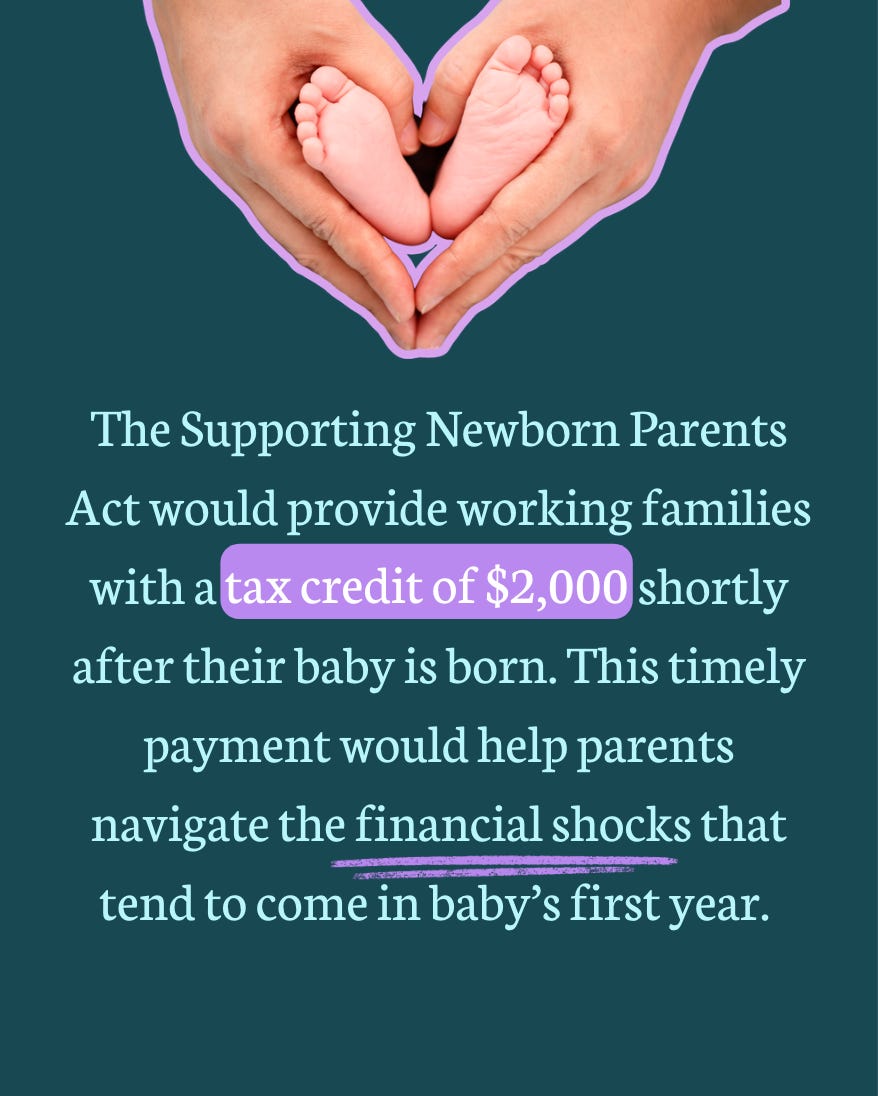
The bill is a ways from becoming law, but getting a team of bipartisan, serious representatives behind the effort is a good first step toward seeing this bill included in a big tax package down the road. The bill got endorsements from serious think tanks on the left and right, too.
If you’d like to go into the weeds on the design of the program, I’ve got a detailed writeup here. And I’ve got a short explainer below
For the last two years, I’ve been working as a Senior Policy Analyst at the Niskanen Center, with a focus on family policy. I’ll still be doing some family policy work with them as a Senior Fellow, but, this week, I’ve started a new job as the Editorial Director at the Institute for Progress. This blog remains just for me, without being run by any of my employers, past or present.
And I’ve got a recent piece up at the Dispatch on the flexibility of people’s plans for future children. The data you collect on fertility plans can change a lot depending on how you ask the questions:
One pilot study contrasted how women answered a stark question about whether they were currently trying to get pregnant, offering the options “yes,” “no,” or “don’t know,” and found that only 2 percent of women picked the ambivalent answer. But when they offered the same women a broader set of options (“trying to get pregnant,” “wouldn’t mind getting pregnant,” “don’t know,” “wouldn’t mind avoiding pregnancy” and “trying to avoid a pregnancy”) 10 times as many women (22 percent) picked one of the middle three ambivalent options.
Plus…
In practice, most fertility questions are more complicated than yes or no. It can be helpful to talk about fertility intentions in the aggregate, but not so helpful to ask a friend, “So, are you done, or do you want another?” when she’s holding a newborn in her arms. The answer she may give immediately postpartum isn’t necessarily the answer she’ll give by the time her cycles resume, or when this baby becomes a toddler.
There are some contexts in which “how many children do you want?” is a helpful question. If you know you hope for three or more, then, realistically, you’d like to try to get started sooner. If you want a larger family, then advice that presumes babyhood is a brief, passing interruption of your real life won’t be helpful to you. High attachment parenting has a very different cost for a mother of one than a mother of four. But, for the most part, you only have to make choices about one baby at a time. You can’t decide whether you feel ready for baby N+2 until after you’ve had baby N+1.
I had fun writing this, and I’d be curious about your own experience making plans about future children.
After we had baby #3, my husband left full time military service and went to graduate school and then we made the decision for him to go on to a PhD in another country, where we were mostly living on savings and support from family and friends. All that was in a time frame where we thought we would be trying to conceive again. Many things made that feel impractical. Once he was done with that schooling, I suddenly had a moment, speaking to a young mom's group, that I didn't "fit" with that group anymore. I had moved on. It was a very strong sensation that I hadn't felt before. We took that as a sign that we were "done." Fast forward another 6 years to when child #3 was 10 and we had a surprise baby #4. Sometimes you're not the one who determines that you're done!
I love that you're discussing nuance in family planning! I always have a hard time explaining my "planning" style to people who just ask flat-out "So, are you done?" Or, after just giving birth to girl #4, "Are you going to try for a boy?" My answer then was "It's too soon!" Ask me in a few months!
Have I ever personally felt like I was "done"? No, and I'm not the kind of person to have strong gut feelings or "signal graces", yet. Our default mode is still "well if/when we have more kids..." and we still orient our lives toward the likelihood of having at least one more (possibly more than one more). But it does shift from "not right now, but probably eventually" to "it wouldn't be the end of the world if we got pregnant right now" to "ready for whatever" and so far it's never gotten past that stage before we did in fact have another.
I'm seeing some other comments about $2000 not being enough or not coming at the right time, etc. and I feel like this is a case where maybe we shouldn't let the perfect be the enemy of the good. BUT we definitely can't let it be an excuse to do nothing else. I don't know all the answers but family-friendly society isn't built on laws and tax incentives alone, a huge part of it is cultural priorities. But you can't legislate a sudden culture change, so here we are. If we can't do a lot, that doesn't mean we should sit back and not even try.