

I enjoyed most of Catherine Pakaluk’s recent NYT op-ed “Life is Better with Siblings.” Pakaluk is the author of Hannah’s Children, an ethnography of college-educated women with five or more children. She is currently working on a companion book focused on dads of large families.
Her NYT op-ed urges parents to turn away from a high-control, risk-averse approach to parenthood, in which you try to make things perfect for your kid. As every parent knows, adding siblings means adding chaos and giving up control. (With three, we often have bedtimes that would be stable but for one kid provoking or disrupting another).
Pakaluk argues that the small polity of a large family gives children more opportunities to develop character, because they must learn to live alongside unchosen people. And it means parents don’t burden themselves with the idea they must be everything to their children—they will play with, fight with, and model themselves on other people too.
Most of all, she writes:
I know this from my own life. My mother had her last two children, my seventh and eighth siblings, when I was in high school. Their births were the happiest times of my teenage years. My social life could be up or down, but those kiddos always adored me. I wanted to live up to the role. My youngest siblings kept me closer to home, and provided ballast through the inevitable difficulties of those years. They are still my closest friends, the first I turn to in hard times. […]
These were not exceptional cases. I wasn’t even probing for them. But mother after mother described some version of the same dynamic — a struggling older child steadied, sometimes significantly, by the responsibility and tenderness of caring for a younger one. Today’s middle-school- and high-school-age children rarely have that experience. They do not share a home with an infant or an adoring toddler. Many will not even remember a time when they did.
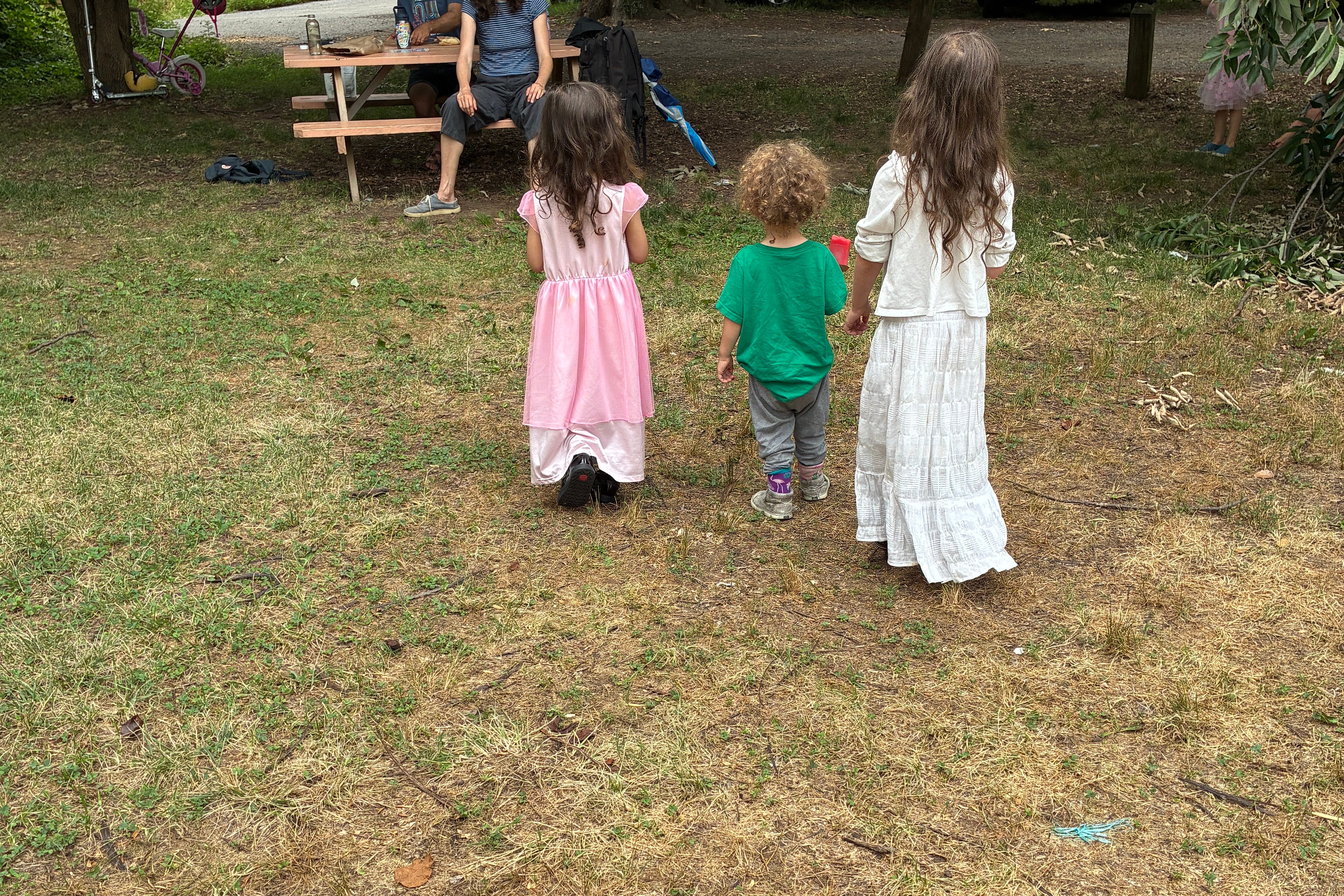
I’ve seen this play out vividly with my own children. Each of my two older girls are very different people than they would be if they were not big sisters. This is most apparent with my middle girl, who was happy to tag along in the shadow of her big sister until her little brother was born.
She still wants to do big kid scooting and imaginative play, but she also locked on to a person younger than herself, adopting him as her special responsibility and shooing me away. “I be his mama now, Mama, you be da babysitter.”
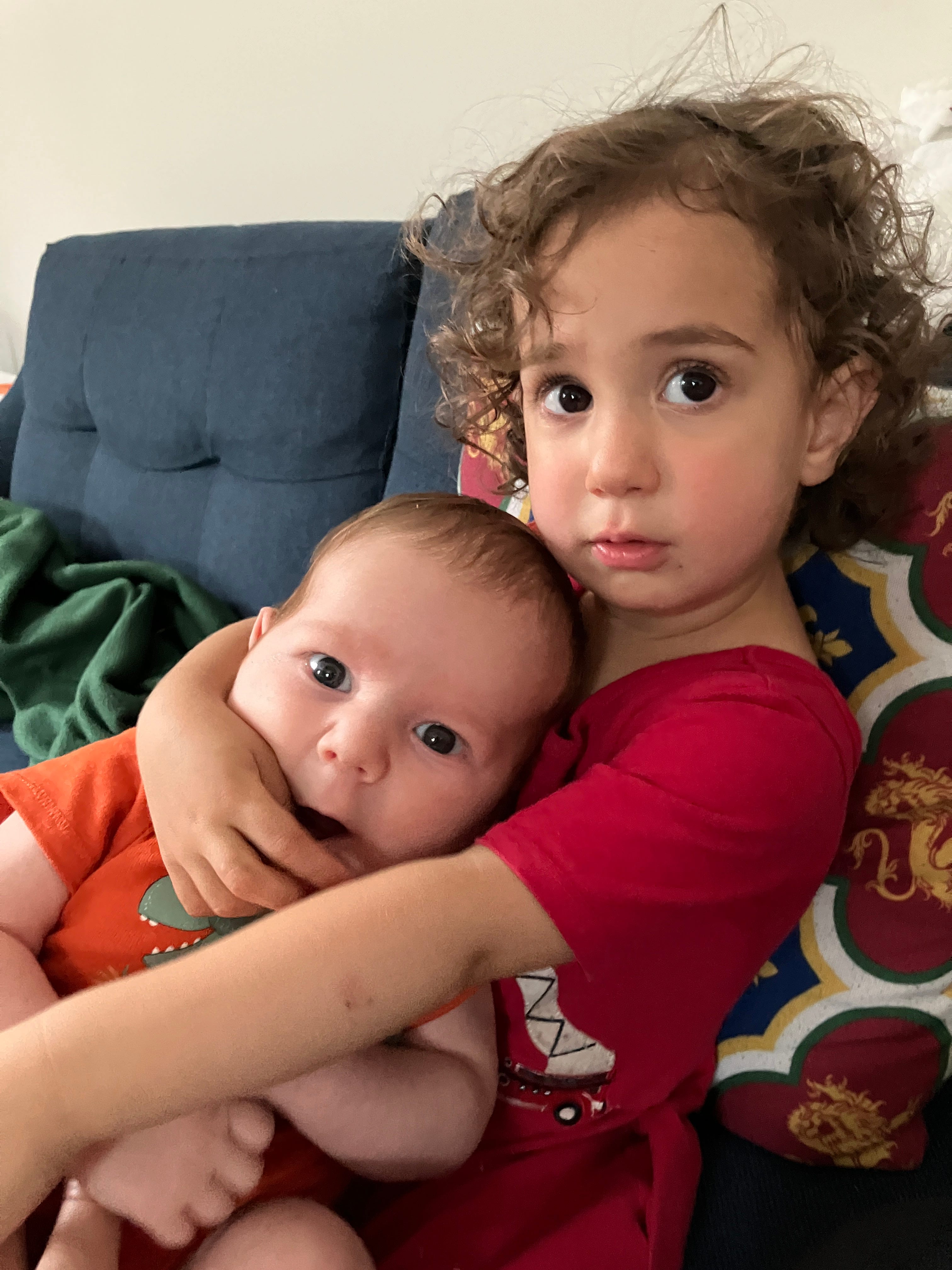
He may follow her into a new tenderness, but it’s too early to know if it will be via a younger sibling of his own. However many kids you have, there is always a last baby, and civilizing that child requires turning outward.
I wrote a little about this, while I was still pregnant with my son, in The Dignity of Dependence:
The new rules [NO JUMPING ON MAMA’S BELLY] came before they could have a face-to-face meeting with the person they were safeguarding. These “nos” certainly prompted some conflict and screaming, but my period of need also drew out unexpected tenderness. Even a two-year-old is big enough to sometimes catch the awe that accompanies fragility. But for her to learn this open-eyed, open-hearted response to weakness requires risk on someone else’s part. It requires my own bodily weakness, endured through each pregnancy, my willingness to risk a little bit of my comfort and health as she learns care and caution, my willingness to let the girls play with their brother after birth as I balance his safety with the immediacy and intensity of their love.
For whichever child is the last one I bear, a good part of his or her education will come through someone else’s baby. That smallest son or daughter will depend on the greater generosity of friends, family, and strangers. The final child of mine will need to turn outward to those who bear children in their turn and allow my youngest child to crowd their babies with love and try out the special responsibility that comes with largeness and strength.
Thus, I think it’s fair to read Pakaluk’s piece as for siblings, certainly, but also making a strong case against a norm of age segregation for kids broadly. Young kids need more than near peers and adults. They need to be responsible for small babies and look up to bigger kids.
I love the Roots of Empathy program, that brings a baby into kindergarten for repeated visits, so the littlest students learn how to be tender with someone small:
Roots of Empathy instructor Marilyn Enloe visits the classroom 27 times over the course of the year and for nine of those visits baby Claire will be there as well with her mother, Jenny Fitzpatrick. It’s Enloe’s job to help students observe the baby’s development and to label Claire’s feelings.
The class then reflects on why Claire is either happy or sad and discusses how the children often have similar feelings…
As for Jenny Fitzpatrick, Claire’s mother, she says she was never worried about bringing her daughter into a classroom and that she enjoys watching the kindergartners’ reactions.
“The tone of the room changes when Claire comes in,” Fitzpatrick said, “and I think kids start to think about how it feels to be treated a certain way, because they don’t like it when she gets upset.”
If you had a larger family, with many siblings, where did you benefit from the demands they made on you?
Where (when growing up or as an adult) do you spend the most time with people of a very different age than yourself?
If you have kids, what are the least age-segregated spaces you go?
Do you have near peers, five to ten years older than you, with whom you have deep friendships and look to as examples? How did you find them?
(I have some other caveats about Catherine’s piece, but I’m sticking them in the first comment to keep this post focused)
There’s one sub-theme in the piece I do disagree with, and I want to make sure to note it:
From Catherine:
> Keeping the door open for another child trades on a wisdom offered by the mothers I interviewed: that more people are never a problem for a family, a nation or any one child.
Of course they can be a problem! Kids are always both gift and cross, even in the best of circumstances. Eve Tushnet has written about her experience working at a crisis pregnancy center, and, for the women she served, her kids were definitely people who brought problems: https://www.commonwealmagazine.org/why-they-call-us
From Eve:
> Most of our clients believe strongly that they have a moral responsibility to attain financial stability. They feel intense familial and internal pressure to graduate from high school, then college, and then to get a stable job. They want to be, if not homeowners, at least people who live independently from their parents. A baby will never help them do this. A baby (a first or second or third baby) will always make the snakes-and-ladders upward scramble slower and harder and more uncertain. Sometimes the conflict between baby and financial stability is blunt and brutal: last year, two D.C. police officers came forward to say that, when they were cadets, they aborted their pregnancies because a sergeant told them that having a baby would cost them their jobs.
As Eve writes, some of these pressures are deeply unjust. But even in a much more pro-woman, pro-baby world, a baby would still put some plans out of reach.
As the almost youngest of a large family, I'm really intrigued by how much of the big family discourse, at least in my experience, seems to come from older siblings. I hear a lot of "I came from a big family, so I am really comfortable around kids" or "I've been changing diapers since I was ten" but I almost never hear the perspectives of the younger siblings. I don't know if that's just my experience or if younger siblings don't talk about it as much. My experience of growing up in a big family is not much like the big family discourse I often hear.
As an adult, though, I appreciate having several siblings because we can rally. We live far apart (siblings are 2-12 hours away from me) but when someone has a hard time, we'll rally for door dash or flowers or something. We share the work of figuring out what gifts to get our parents - one of us has an idea and the rest chip in, and then we can get them nicer things, too. We have an active WhatsApp thread and it's good for me to hear from people who are not like me - I love my siblings but I often wonder how (or even if) I would have met them if we didn't grow up together. We've taken different paths in our adult lives and it's good to have constant, loving exposure to different kinds of people.