

I got to contribute to Plough’s symposium on suggestions for a second national anthem. I was the only person to pull from Broadway, suggesting “Till We Reach that Day” from Ragtime.
Adding this song to our national repertoire would serve the same role that the psalms of lament do in the Bible. These psalms offer an invitation to prayer, and thus to hope, even in the bleakest moments. “Till We Reach That Day” does not reject America as rotten at the root, but it dwells in the wounds. It’s an anthem for America’s Puddleglums, who are fiercely loyal to a country they’re not sure they’ve ever inhabited.
And tomorrow, August 18th, I’ll be giving a talk online for the Institute of Catholic Culture on how to build thicker Christian community. I’ll be drawing on my second book, Building the Benedict Option, which a handbook of ways to build up community wherever you are right now, over the next two weeks to two months.
I really enjoyed the conversation that broke out in the comments of “A Large Family is a Polity” last month. I had shared (with some caveats) Catherine Pakaluk’s NYT op-ed “Life is Better with Siblings.” What I liked most about her piece was her emphasis on how belonging to a larger family gave children a sense of belonging to/being responsible for siblings who weren’t age peers.
Some of you had excellent stories about how your community let kids of different ages mix, no matter how large their families were:
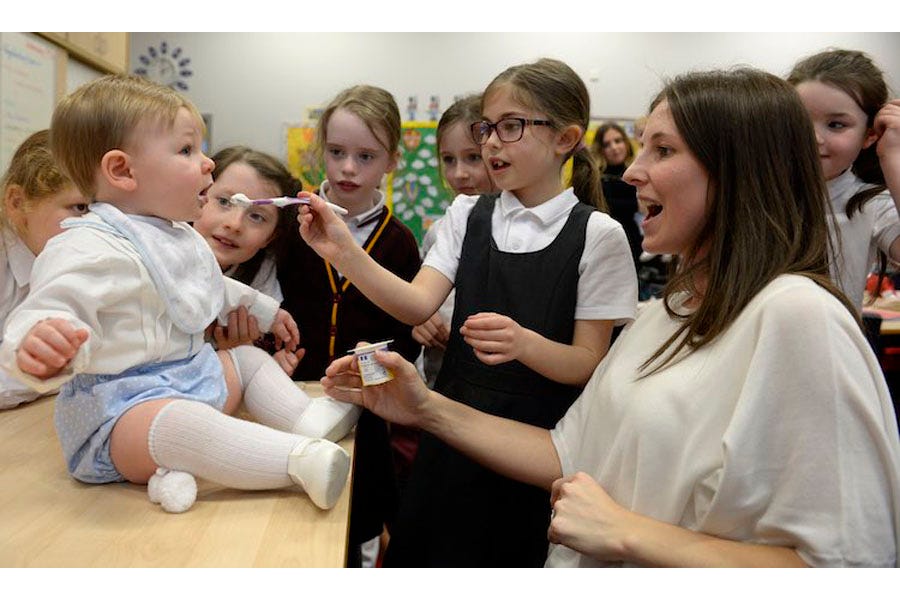
I liked Jenny’s story about a baby who came to school:
I don’t have a perspective on big families, but my son’s teacher had a baby and upon her return to work, brought that baby into her age 3-6 primary class for the better part of a year. The students *adored* him, were so careful and tender with him, and the mama/teacher got to keep her baby in sight for an extra ~7 months or so before he graduated to an infant care room on the campus. It was such a win-win, and that teacher was so brave! to trust her masterpiece to a classroom full of preschoolers.
And I love how large and sprawling Mary Ellen’s family has become… by running a Catholic Worker home for moms and babies:
Our life is spent at a Catholic Worker women’s shelter, so there’s always a baby. Our choice was a smaller family-- 3 kids and a constant rotation of single moms with toddlers. As such, my kids take on child care all the time, often unpaid, and are often adored... But also learning how to draw boundaries and enforce discipline. We took a big group of older kids on a field trip yesterday and my teenage daughter noticed they were getting bored and immediately broke out her repertoire of camp songs. My middle kid finds the introverts and takes them aside, knowing that was once him. My youngest will never be the youngest. So much to love about a life of faith and action, but this post highlighted the large family we have that keeps getting larger.
I asked where people saw the most age mixing in their community, and the two most common answers I got were church and homeschooling co-ops. (Which is very different than my own experience growing up and knowing only my own grade, plus a little mixing in extracurriculars).
Leslie had a particularly wide set of examples of age-mixed spaces:
Homeschool co ops are some of the least age-segregated spaces that we visit. This has been one of the best things about homeschooling. It is not something that everyone can or should do – I myself have doubts about it. But mitigating the strict age segregation of our society has been one of the biggest rewards I’ve found doing it. I feel like this could be recreated in schools to some degree. I mean, you wouldn’t have to make everything a one-room schoolhouse, but there could be more intentional effort to mix the ages.
Church is another place where the kids can often interact with a variety of ages. But this is hit or miss because a lot of churches themselves are very age segregated. We happen to go to a small church where there’s a lot of interaction with adults just because there aren’t that many other kids.
We are very lucky that we live in a neighborhood with a lot of kids. One of our neighbors started kickball at the local park on Friday nights. There’s a decent-sized group, and there are mixed ages from high school down to elementary. I don’t know how common something like this is- it’s very informal, and the kids are mostly in charge. Sometimes adults do come and play as well. But mostly it’s the group of kids playing and working things out. To me, this seems like something from a bygone era, but I’m really grateful that our kids get to experience it.
William took aim at the narrow, nuclear family:
To expand on the point of there always being a last child, however, I would argue that’s an issue mainly because of the unique way we modern Americans live. Most people historically don’t live, as we do, away from extended family. If we lived in the same home or neighborhood as our cousins and uncles and aunts, the youngest child would almost always have nieces and nephews to bring out and train the instincts of parental responsibility in him. Same with the only child caveat; it doesn’t have to be unfair to them, as even they could be around baby nieces and nephews, or even just the children of neighbors and friends, if only he lived in a proper community. Today, a person like me, who grew up with many little children around to love, to require care, and to keep me attached to my home, is one of a very privileged few. That is truly an injustice. But in a healthy society, this would be the norm for most everyone.
Roxane was grateful for her own sister… and glad her own children have a larger family:
I had only one sister, a year and a half older, and while she was my world in so many ways, I see how that (more siblings) has only become exponentially more helpful as my children grow and begin to have adult relationships with one another. Our kids have so much more than I did with just one sister. Again, it was a great relationship but we were less connected at this stage than most of our kids are now. They just got done having a "Salonen kid" party at our oldest daughter's lake town -- without us. Which is great, because we're likely to be gone from this earth sooner than they and they will have each other.
And I want to make sure I amplify Mary’s question about how the youngest members of large families weigh their experiences:
As the almost youngest of a large family, I'm really intrigued by how much of the big family discourse, at least in my experience, seems to come from older siblings. I hear a lot of "I came from a big family, so I am really comfortable around kids" or "I've been changing diapers since I was ten" but I almost never hear the perspectives of the younger siblings. I don't know if that's just my experience or if younger siblings don't talk about it as much. My experience of growing up in a big family is not much like the big family discourse I often hear.
Two of my kids attend a small Montessori tutorial that has 1st-5th graders in the same classroom, and the benefits have been absolutely off the charts. My oldest had always been the oldest by a few years of all the kids in our friend group, and it was a humbling experience entering the program as the youngest - but he needed that lesson in humility, ha! Now he's in 4th grade and gets to be a helper and an assistant teacher to the younger kids, which in turn reinforces the material in his own mind. It's such a win-win!
I am married to the oldest of eight. When the youngest was 10, he became an uncle for the first time. So though he spent ten ish years being "the baby" of the family, he now has the nieces and nephews around to take care of.