

This Thursday at 7p, I’ll be speaking at the JPII Shrine in DC on how to have better arguments. On Friday, I’ll be speaking to the The Dallas Forum on Law, Politics, and Culture on “Against the Idol of Autonomy.” And last week, I did a Mad Libs debate with Jerusalem Demsas of The Argument on whether women and doctors should expect abortion bans to prohibit miscarriage treatment or lifesaving care (paywalled).
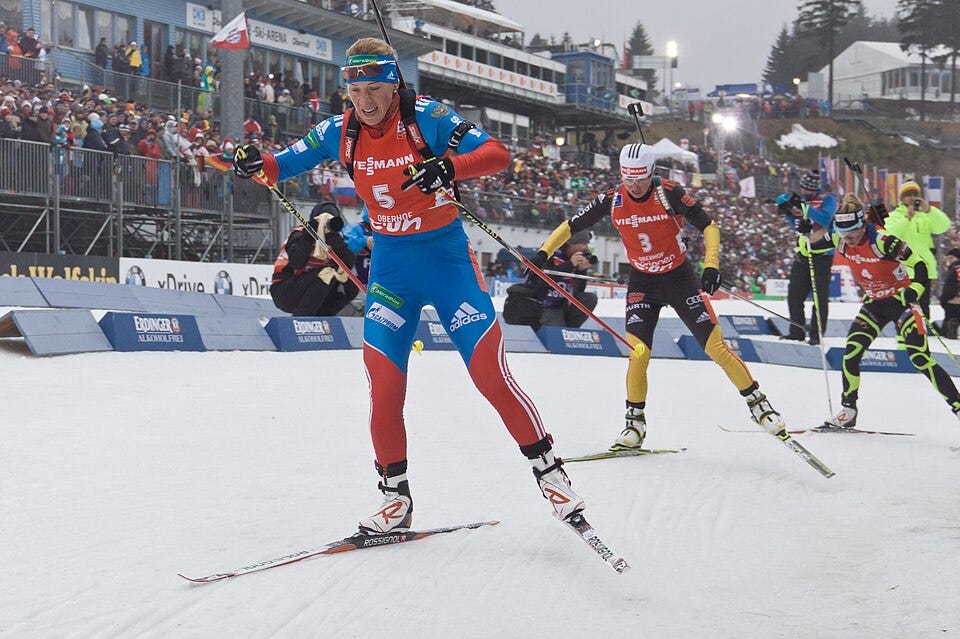

My kids and I enjoyed the Olympics at the normal level (watching figure skating, primarily; going “why would you do that?” at ski jumping), and I enjoyed the Olympics at a special, Other Feminisms level when I read articles like this in the Athletic: “At the Winter Olympics, full gender equality remains a work in progress.”
Most Olympic sports are pretty tightly mirrored across genders (the hundred meter dash is exactly the same race) though some are more differentiated (male gymnasts have pommel horse; women have the uneven bars). The Athletic piece linked above is interested in gender differentiation in ski biathalon, where competitors need to both race on skis and shoot accurately at targets.
In the relay ski biathalon, men and women have different distances to cover in their cross-country skiing relay legs in their respective divisions (7.5km for men, 6km for women, 6km for everyone in the mixed relay). The Athletic author, Matthew Futterman, is concerned that this difference means “an explicit message of women as weaker remains.”
But Futterman’s interviews surface another explanation: Max Cobb, the general secretary of the International Biathlon Union, says:
He said the shorter distances are meant to have women racing for a similar amount of time as the men. That maintains a consistent ratio between the time biathletes spend shooting and the time they spend skiing. If women ski as long as the men do and don’t do it as quickly, that ratio gets out of whack and overemphasizes skiing for the women and not for the men.
I don’t know biathalon well enough to assess this (obviously!) but I do find it an interesting example of where equal may not be equitable. Futterman pretty clearly hopes that, as women train harder and ski faster, the equal and equitable might converge, avoiding a tradeoff. I doubt the asymmetry will ever totally dissolve.
The first chapter of The Dignity of Dependence has a lot more about basketball than I imagined in my original outline, because sports offer vivid examples of how contentious “fairness” is when it comes to the asymmetry between the sexes.
University of Connecticut coach Geno Auriemma came out swinging against the [NCAA decision to have two different three-point-lines for men and women]. He told ESPN that the two visible lines on the court hurt women’s standing on campus, saying, “Please. Like another indication that, what, we’re not capable?” It was an expansive “we,” since at six foot one he stood taller than many of the women he coached.
In 2021, the NCAA brought the college women’s line back to the same distance as the men’s. The women’s three-point shooting percentage dipped, but analysts expect it will eventually stabilize with practice. And even if it didn’t, a little sag in the number of perfect swishes is a lot less obvious than the sweep of two separate lines on the floor.
Not every woman can land a shot from the three-point line. But every woman faces the same question the WNBA and college women’s players did — When is it worth it to us to call attention to our embodied difference?
And, on the topic of asymmetry, I really enjoyed Elizabeth Oldfield’s essay at Capita, “Towards a Feminism of Interdependence: Why the Common Good Requires a New Feminist Politics.” (I’ll be on her podcast soon). She writes:
I came fully into a feminist identity during my first pregnancy, when the stark chasm between my experience and my husband’s, mine and my male colleagues’, could be felt in my bladder, my dislocating pelvis, my foggy brain. I was leading an organization and was roundly patronized by older men who made no secret that they saw leadership and motherhood as incompatible. One funder threatened to pull their support because they “didn’t want to fund [my] maternity pay.”
She and I are in agreement that no one can pretend to be autonomous forever, but that women tend to get caught first as failing to live up to this impossible standard:
At least half the population cannot cosplay the autonomous, independent, male-coded model of a desirable human life as well as the other half. It is a charade for both, a trap for men too, but their own reliance on and calling to care is easier to hide and more socially permissible to avoid.
And I really love both the specific way she chooses to live out interdependence, and her broader invitation to readers:
We are soon to be eight people living together—my husband and two children, another couple who are pregnant, a single person (and a cat). It was a long, difficult road to get here. […]
My vision of the common good, a vision we are trying, deeply imperfectly, to step closer to in our house, is one where we stop pretending to be imaginary autonomous individuals and live more fully into our irreconcilable interdependence. In practice, that looks like a cascade of care. Care flowing through a set of concentric circles we all participate in, which overlap and through which we dance between giver and receiver, more intense and less intense seasons. In this vision (which does not require a radical household like ours) we recognize our collective need for care and are invited to contribute according to our gifts.
I’m looking forward to visiting friends living in a large group house (two couples, three babies, assorted other housemates I’ll have to tally when I get there). It will never be the most common way of living in an interdependent way (the housing stock you need is rarer than single family homes) but I love the lively village-ness of it all. Not to mention, no one needs to book a babysitter for rpg nights after the kids’ bedtimes!
For a "care in a crisis" example, last week I had an unexpected hospitalization for a couple days in week 28 of a high risk pregnancy. I'm fine, baby is fine (and still on the inside for now, thankfully!)
When my mom (who lives on my street) didn't answer her phone on the first try, I had half a dozen friends within a few blocks of my house whom I could text to ask if they could come over to watch my kids until my mom could come. It turned out she was just checking out at a nearby store and was able to stop over before anyone else came, but I already had backup offers in case I needed them. I felt so grateful! Then my sister-in-law made dinner for my mom and my husband and my kids and dropped it off to them while I was in the hospital. I got so many kind texts from friends while I was in the hospital, in what could have been a very lonely, stressful time.
Psalm 68:6 God sets the lonely in families...
As we start Lent, I'm so thankful to be set among the family of my friends, even in challenging seasons! I don't know if I'll have unexpected bleeding again in the next several weeks and if I do, they'll likely do a c section that week. This means I'll have a very "trusting in God" Lent and I'll try to hold my plans loosely (very hard for me as a Type A planner!). Building up this walkable neighborhood has taken years and commitment and investment, but in both normal weeks and crisis weeks, near proximity makes it so much easier for us to be there for each other!
Where to set the distance of the 3 point line in women’s basketball?
The answer is contingent on the desired results. If one wants the women’s game to look more like the men’s game, one would shrink every dimension. The ‘slam dunk’ is common in the men’s game but rare for the women because they both play with a basket at 10 feet above the court. If the basket was at 8 feet for the women, slam dunks would be common. The pace of the women’s game would look more like the men’s game if the overall court dimensions were smaller. But I would not want this. The women’s game is different than the men’s game - and one can enjoy the women’s game if you’re entertained by these differences - as I am. I trained my daughter to play basketball and watching her play was a joy.