

Over at The Dispatch, I enjoyed writing up my first adventure in vibecoding with Claude. The issue was that I’d had a browser extension I’d wanted for years, but which no one else had written. And I was reluctant (with little kids) to go all in on learning to write extensions for just one use case.
I wanted an extension that interrupted my use of twitter. When I opened the site, I wanted an interstitial page that showed a prayer intention, randomly chosen from a list I could edit, and gave me time to pray before I could go on to Twitter. And now… thanks to Claude… I’ve got it.
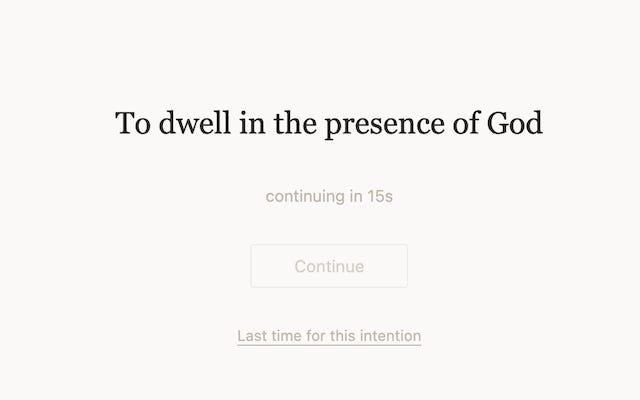
I’ve been using it every day since, and about 30 people have joined me. It works just as I hoped—sometimes prompting me to close the Twitter tab I opened mindlessly, sometimes just subordinating the virtual social network to the spiritual social dimension of prayer.
I accepted one form of friction (the struggle to master a new coding tool) for the sake of precisely controlling the form of friction I really cared about. I’m excited about the future of vibe coding (code written through prompting AI in plain English, rather than in coding language) because I think it will give ordinary people more control over their screen-mediated life. Vibe coding will make it a lot easier for everyone to reshape and resist the glide paths laid out for them by Elon Musk, Mark Zuckerberg, and others. Especially people who have never coded at all.
My next project was making a custom tool to help me, my husband, and our friend plan our GenCon schedules together. I like feeling like more of the world is tractable. It’s like a 3D printer, but for processes, not physical objects.
For a cautionary note on not having friction in the right places, try this from Eve Fairbanks for The Atlantic.
Ten years ago I composed a reconciliatory email to a boyfriend but never sent it, because I couldn’t get the phrasing right. Only much later did I realize I simply didn’t mean what I’d been trying to write. If I’d had an AI program to help me get over the hump, I’d be married to a different person. A much less suitable one.
Finally, on the AI front, I had a wonderful time sitting down with Oren Cass, Chris Griswold, and Max Bodach to talk about the pope’s new encyclical Magnifica Humanitas. I’ll have a little more writing on the encyclical coming out in the next few weeks, but I loved doing this podcast with good faith interlocutors who are interested and interesting. Half the table is Catholic, half not.
I got to host a Magnifica Humanitas book club at my house last week, and when everyone introduced themselves, I had them mention what their use of AI (if any) looked like. We had a big spectrum, from someone actively trying to step back from her current level of reflexive use, to a missionary living in a house where they didn’t use the internet by default.
I really enjoyed discussing these tools with women all focused on how (if at all) they could help turn us toward the fully human, rather than away from each other.
I use an app to put friction between myself and my phone web browser. It is a good way to break a bad habit but it's ridiculous, really, to use tech as a barrier to tech. My real preference, if I could, would be not to need a smart phone in the first place, but I live in a world where you get punished if you don't.
I cannot imagine ever, ever, ever wanting to vibecode anything, not for my household or personal life or anything else. The very idea of using anything with any sort of LLM input makes me feel ill. Any kind of LLM use replaces possible human encounters, expression, communication. Even seemingly trivial texts, like coding, are a field for human thought, expression, and culture, and even though I would very much struggle to program anything that's not super simple the very idea of having my thought being replaced by LLM output is extremely offensive to me, it's like being told I shouldn't learn new skills or think or have a voice. I don't think vibecoding can ever be a form of resistance. It's just another way of being complicit with a worldview where more and more inherently deep, complex activities (writing, communication, coding, art, design) are treated as trivial, subhuman and lacking social or cultural possibilities.
I was thinking about opening chapter of The Dignity of Dependence yesterday when taking the train back from my book tour stop in Santa Barbara. My seat was so uncomfortable because I am short and my feet could not reach the footrest!