

This Thursday (Nov 5) I’ll be in Cleveland for a talk on The Dignity of Dependence. Next week, I’ll be in Pittsburgh Friday and Saturday (Nov 13-14) to keynote a symposium on Magnifica Humanitas. Let me know if I’ll see you there!
Also, if you attended the Fairer Disputation Conference in Rochester and heard my call to action in the last session, can you fill out this brief survey (even if you didn’t do what I asked!).
For non-attendees, I asked Rochester folks to think of three women in their lives they could reach out to for a continuing conversation, so the Convention wouldn’t end when travelled home.
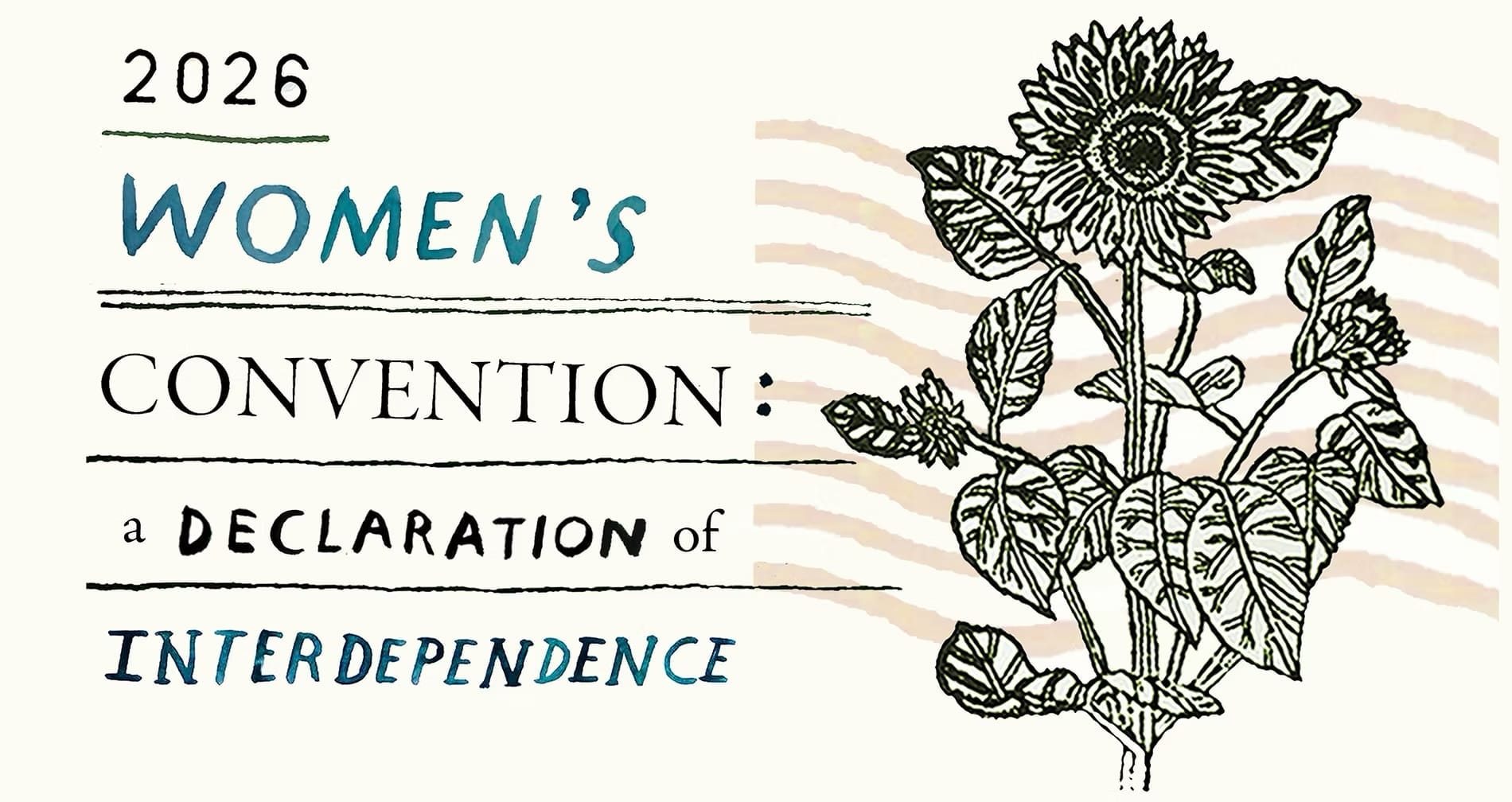
And speaking of the Rochester Convention, it was interesting to see how the gathering looked to people not already sold on the ideas. The Argument’s gender reporter Maibritt Henkel came, saw, and critiqued. Today, I have a response at The Dispatch.
My Dispatch piece is focused on just one question Henkel raised. I tackled some of my other objections elsewhere: you can check my thread here on what happens when you set “universal childcare” as the bar for “takes family policy seriously.” (I’m also sorry that the author was disappointed not to see more leg hair, I would have lifted the hem of my slacks if I knew she was taking a census.)
But my focus in the Dispatch piece is based on Henkel’s good-faith question—can you have a movement for women that is rooted in biology that doesn’t wind up reductionist or narrow? As Henkel sees it, “The view is basically that, if you have a uterus, your entire life, from the day you are born to the day you die, is defined by this physiological trait.” Some attendees at the Rochester Convention asked the related question: are you accidentally (or intentionally) building a movement just for moms?
In my response, I try to explain why I’m interested in all asymmetries between men and women, but pregnancy (or the potential for pregnancy) is always going to be one of the most stark asymmetries + one of the obvious routes into solidarity.
The asymmetry of pregnancy is the most obvious difference between men and women, but it isn’t the only important distinction. Women are biologically different from men, and that shows up in our heights, our hand size, our hormonal cycles, whether you ever have a baby or not. Caroline Criado Perez, the author of Invisible Data, has excellently chronicled the ways that the built world is often designed with men as the default and women as the defective user. You don’t have to have children to be endangered or inconvenienced as a woman by drugs that ignore your hormonal cycles, tools the wrong size for your hands, or an airbag that was never calibrated with a female-sized crash test dummy. Criado Perez might not describe herself as a “sex-realist,” but all her work is informed by a practical realism about the biological asymmetries between men and women.
In my book The Dignity of Dependence I argue that our culture gets two major things wrong about our embodied, sexed nature. First, our culture often premises the equal dignity of men and women on our interchangeability. (But since men and women aren’t fully interchangeable, our claim to dignity, at least through that route, is fragile.) Second, for both men and women, our culture sets forth an ideal of autonomy, something that isn’t achievable for either sex. We begin our lives obviously dependent, we end our lives the same way, and we spend a great deal of the time in between relying on others.
If you’re living in a world shaped by a lie about the human person, what forces you to realize there’s something wrong with the story, not something wrong with you? For women, pregnancy is often the tipping point: While you’re pregnant or caring for a very young child, it’s more obvious that you can’t live up to the ideal of autonomy. And the mere potential to be pregnant offers women an invitation to solidarity, whether or not they hope or expect to carry a child. Men will also eventually notice that they are not autonomous beings, but for men, that realization is likely to happen later in life (through aging, illness, or injury), and not at roughly the same time as their peers.
When I planned the chapter structure of The Dignity of Dependence, I made sure to strongly foreground non-pregnancy, non-fertility asymmetries in the first chapter (there’s a lot about the placement of the three-point line in women’s basketball). I wanted to be clear that this is a book about what it costs women (all women!) to pretend we are fully interchangeable with men.
As the chapters turn more to care, specifically, I’m interested in what kinds of care get made invisible or treated as optional because the connection isn’t as biologically undeniable as a baby tethered to his or her mother (by umbilical cord or by nursing). And that means single people have (unfortunately) especially fragile claims to care and need advocacy and deliberate inclusion. More from the Dispatch piece:
Contrary to some claims, my form of feminism (whether you call it sex-realist, postfeminist, integral, or anything else) doesn’t see motherhood as the destiny of every woman. I’m Catholic; I certainly don’t believe all women must be mothers to live full and flourishing lives. I turn through the pages of Saints Around the World with my son and my daughters and tell them the stories of men and women who lived lives of heroic virtue, single or married, in religious orders or as laypeople active in the world. As my children grow, I’ll retell the stories with deeper attention to how the different obligations they may take on will free them or bar them from certain forms of love as self-gift.
The nursing mother is less free to sit by the bedside of her dying father than the single woman. The man in a religious order has already chosen a form of laying down his life, and does not have to weigh whether a war is just and whether he owes it to his nation and his neighbors to enlist. In the same way as members of religious orders may make vows of stability and commit to a single convent or monastery, married people (especially with children) are more tied to a particular set of loves and obligations. Persons who are single are freer to make sudden commitments in a crisis, but also are more likely to struggle to find someone committed to them in their crisis. My family has prioritized inviting single friends or friends struggling with infertility to be godparents to our children, to create a permanent relationship of love and obligation.
These lateral ties are also a major focus of my handbook for creating thicker community, Building the Benedict Option.
And, in other news, I was delighted to get to join Santi Ruiz and Caleb Watney for an episode of Statecraft focused on philanthropy and where you should work to have a big impact on the world.
I think it’s pretty likely, if you know me primarily through The Dignity of Dependence, you may not know I once ran HR for a remittance company (Wave) that was founded by people who were trying to start a company that would do more good for the world than the founders could do by maximizing their earnings and donation potential alone.
The more they could streamline remittances, the more money people in the US and Europe could send home to their families in some of the poorest places in the world. As the company grew, the founders also focuses on building out mobile money/banking by phone. (A Phone is a Cow is, I’m told, a good book on why this makes such a difference).

One exchange I think everyone here at Other Feminisms will enjoy is this between the three of us (with seven young kids between us):
Leah: How do the virtues of working in a high-volatility environment as a philanthropist, with a wide variety of recalcitrant stakeholders, cross over with those of being a parent to two young kids? Which virtues are helpful in both domains?
Caleb: Emotional stability is very important. Compartmentalization is also useful. When you’re working on AI policy, you’re often thinking about extremely heady, uncertain things that, if they happen in the way some people predict, have existential stakes. It can be very easy to let that become all-consuming. I find it very balancing to go home and have my two-and-a-half-year-old say, “Daddy, I want to play catch.” It’s a nice circuit breaker. It roots you in why this all matters, and what we’re all doing it for. And it’s a healthy way of forcing some emotional balance.
Santi: I think the classical answer to your question, Leah, is all of them. If they were domain-specific, they wouldn’t be virtues.
Pregnancy and children are a wonderful invitation to solidarity among women across life stages, but I’ve also found that they can be stark and painful dividers. Perhaps because of what you mentioned to the effect of single people have fewer available friends for when they are in crisis. I may not be able to drop everything and bum around a park while listening to a friend’s existential concerns, but my dinner table is always open and the kids do eventually go to sleep for the night. I wish my single friends knew that they were still welcome even if they are not the premier priority bc kids take precedent.
I think your piece in the Dispatch dodges the central critique of Henkel's essay - that the weekend focused on a critique of feminism rather than digging into how to make the world a better place for women.
"The presentations and panels I attended, as well as the many conversations I had over lunch and tea and cake, seemed gravitationally pulled away from childcare policies and toward the countless evils of liberal feminism: hookup culture, pornography, abortion, birth control, in vitro fertilization, surrogacy — to name just a few."
A conference focused on "feminism" that actively seeks to restrict what women can do, say, access strikes me as worthy of feminist critique!