

This Thursday, February 19, I’ll be at Middlebury College in Vermont, speaking on my new book The Dignity of Dependence, for their Alexander Hamilton Forum. The following week, in DC, I’ll be doing a non-book talk this month for the SJI Institute on how to have better fights on February 26th). The following day, I’ll have a book talk at UDallas, link tk!
At the Institute for Family Studies, I have a pitch that colleges should open a Marriage Office to complement their Career Offices. It’s not about creating two tracks, but being realistic that both career and family require deliberate planning and choices. Especially as life scripts that worked in the past will leave you adrift today:
A college Marriage Prep Office would work in parallel to the career office. Such an office would host new and long-time married couples for informational talks, the same way that they bring in recruiters and alumni. Couples could talk about how they approached dating and deciding to marry. Older alums with kids might discuss how they budgeted for child care, whether they chose to step down or do part-time work, and how they navigated a later return to a full-time career.
The Marriage Office could co-sponsor a lecture with the economics department, and bring in Nobelist Claudia Goldin to discuss her theory of “greedy jobs.” These are the jobs where pay per hour rises substantially with hours worked, so that the wage for working 50 hours a week much more than doubles the price for working 25 hours a week. Prospective parents that go into these fields may feel they have golden handcuffs that prevent them from tapering back work when their children are young. The Career Office might step back in with job advice for thirty-something alums looking to return to work after a pause.
You can read the whole thing at IFS, and I enjoyed compiling some of the college classes that require students go on a date, and which are very popular as a commitment mechanism (pun intended).
Elsewhere, at Word on Fire, I have a review of Carrie Gress’s Something Wicked: Why Feminism Can’t Be Fused with Christianity. Given that my book’s full title is The Dignity of Dependence: A Feminist Manifesto, it’s not a shock we disagree.
I don’t care very much about converting people to define themselves as feminist or not. It’s always been a contested term and a rowdy, internally-contentious movement. I’m upfront about how I define feminism:
A concern for justice to women as women, not as defective men or generic, unsexed individuals.
But part of why this substack is called “Other Feminisms” with an emphasis on that ‘s’ is because even if you’re attracted to that definition, there’s a lot of disagreement about what justice demands. And I’m up to have conversations with a pretty broad range of people of good will.
My problem with Something Wicked is that I think it leaves the reader who is skeptical of feminism less prepared to talk to her neighbor than she was before she picked up the book. As I wrote for Word on Fire, it reminded me of the way that reading the New Atheists left me poorly prepared to debate Christians in college:
Harris and Dawkins were always looking for the worst examples of religion to use to discredit all strains of Christianity. The New Atheists would point toward Levitical laws to cast all Christians as hypocrites, as though Paul had never talked through these questions in Acts. Dawkins dwelt on some Christians’ rejection of evolution, without a care for the work of religious brother Gregor Mendel in figuring out the rules of genetic inheritance. Even when our enemies are wrong, they are more diverse (intellectually and morally) than any broad-brush condemnation can reflect…
Like the New Atheists, Gress is deliberately not engaging with the strongest arguments of her opponents. Her evidence that early feminist and advocate for women’s education Mary Wollstonecraft hated men is a single quote in which Wollstonecraft objects to men holding doors for women. She goes further, saying that Wollstonecraft should be judged not just by her writing but by the “bad fruit” her work bore in her disreputable daughter, Mary Godwin Shelley, who ran away with a married man. Gress neglects to mention that Wollstonecraft died less than two weeks after her daughter’s birth from complications of pregnancy. The book tempts readers to believe they can skip past deep examination of Wollstonecraft’s work, since Gress’s just-so story of “bad mother, bad daughter” gives permission to move on. In fact, they are exposed as evangelists without the armor of scholarship or charity. Are readers really expected to offer the witness that Wollstonecraft was at fault for dying in childbirth?
I recognize these traps, because I fell into them as a New Atheist. These curt dismissals cut off curiosity, and without a real interest in your opponent, it is impossible to win her trust. Gress’s work, like that of the New Atheists, does not form readers for fruitful dialogue: It gives them excuses to disengage. When I read caricatures of Christians, then attempted to talk to real people, the jarring discrepancy pulled me up short. Had the New Atheists misrepresented what they claimed to specialize in? Or were my interlocutors lying? It would be easy for a reader of Something Wicked to walk away from the possibility of conversation (and conversion) the moment her feminist friend says, “But I don’t practice the occult! What are you talking about?” If she places deep faith in Gress, she will conclude her friend is operating in bad faith, making dialogue impossible.
If folks want a great history book that doesn’t oversimplify the past in order to score points in present conflict, I loved Daniel K. Williams’s Defenders of the Unborn: The Pro-Life Movement before Roe v. Wade. The book doesn’t “prove” anything about whether you can be a pro-life feminist or not, but it does a great job tracing how little previous divides over abortion mirrored present ones. It felt like finding a branch of the family that had been erased from the tree.
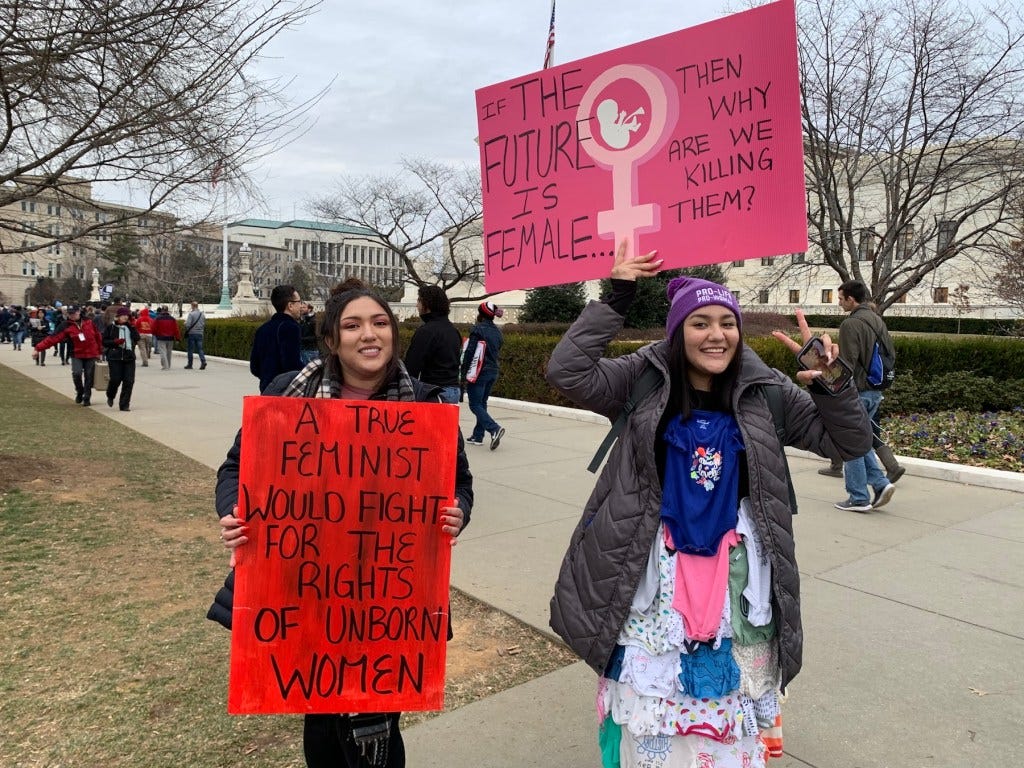
And speaking of pro-life feminism, I’m one of a coalition of pro-life writers and activists who signed this open letter, asking ICE to return to its prior policy that, “absent narrow exceptions, ICE should not arrest or detain individuals known to be pregnant, postpartum, or nursing.”
So, as I turn it over to all y’all in the comments:
One book I found helpful in complicating narratives was Alasdair MacIntyre's After Virtue. He pointed out early on that modern ethical debates are often fruitless because each interlocutor is proceding from entirely disparate premises and ethical frameworks that are untethered to the traditions that formed them. Women who are pro-choice are not "anti-life" in the sense that they are not primarily arguing about whether the child in the womb is a person or not-yet-a-person. Their concerns are more related to the strong sense that child-bearing can be very difficult and can be surrounded by a lot of injustice, especially in the worst kinds of cases that they don't feel equipped to be able to restrict blanketly. Pro-choice and pro-abortion are actually different things procedding from different primary committments. MacIntyre traces this same divide in a few other modern debates, and I think it holds true. We are often talking past each other because we haven't agreed on the premise or even how we are using language, and it isn't because one side is "evil," but because we haven't made the attempt to understand what they are actually arguing for and why.
“Are readers really expected to offer the witness that Wollstonecraft was at fault for dying in childbirth?” 👏👏👏
Mic drop aside… This was an incisive but charitable review for WoF, characteristic of your mission to find common ground and fruitful dialogue. Thank you for writing it!