

First up, for folks in New Hampshire and Vermont, I’m coming your way this week and next!
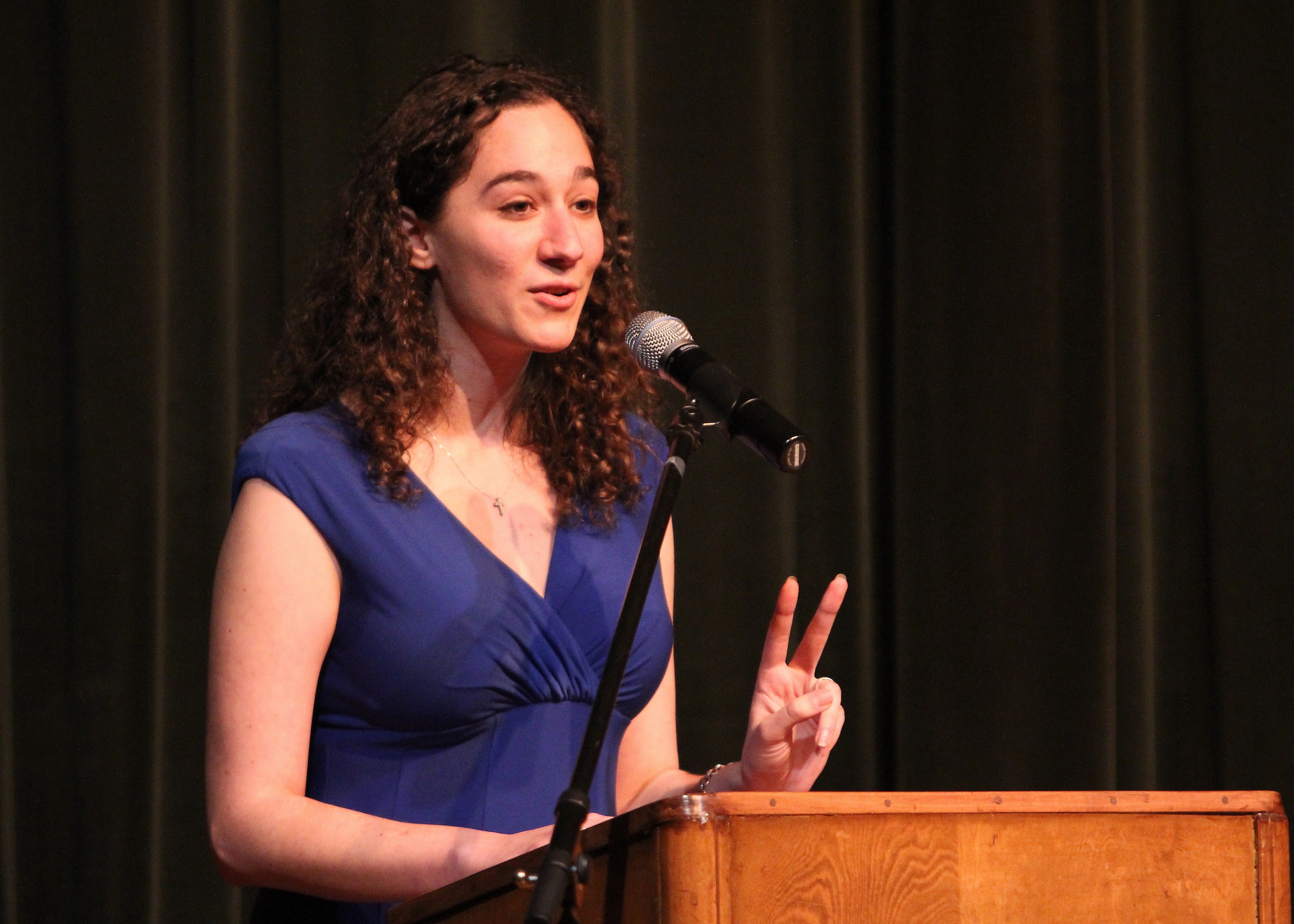
On February 11th, I’ll be at St. Thomas More College in New Hampshire to talk about The Dignity of Dependence.
On February 19, I’ll be at Middlebury College in Vermont, also on the book, for their Alexander Hamilton Forum.
(And DC peeps, I’m doing a non-book talk this month for the SJI Institute on how to have better fights on February 26th).
My spring schedule is extremely closed, but I am taking bookings for the fall.
When my husband I write our goals for the year, one thing stays the same for me: “Write for a new magazine.”
I want to keep expanding my list of places to pitch, and I benefit a lot from getting feedback from diverse editors and thinking about how to reach different audiences. Last year, I was delighted to add Asterisk Magazine to my list.
My piece “Rethinking High School Science Fairs” has just come out. It’s about how professionalism has eclipsed pedagogy in competitive science fairs.
Science exploration driven by genuine curiosity is more open-ended than experiments that come in a box and test students on whether they get the right answer. I remember in my high school physics class we were first taught the value of Earth’s gravitational constant g, and then asked to perform an experiment that should reveal it.
Of course, working with cruder tools, limited patience, and air resistance, many of us didn’t wind up squarely on 9.8 m/s2. One of my partners was quick to scribble out our actual observation, and she and I had a brief struggle over control of the pencil as she attempted to put in the “correct” answer. She had a better sense of the teacher’s intentions than I did. The tables that honestly reported a “wrong” result were encouraged to repeat their experiment until they got a trial that “worked.” We missed the chance to talk about how scientists reconcile noisy data. We missed the chance to run an experiment for the purpose of exploring the unknown.
Students in science fairs and adults in professional labs know the answer they’re supposed to get. A result has to be statistically significant to “count” and, just like in my physics class, students can be tempted to keep reworking their results until they get the right answer. There was no p-hacking at my research internship, but part of the education I received in a professional lab was how much the scientific process was dominated by anxiety, not curiosity.
What I carried out of the lab and what enriched my life didn’t have much to do with the scientific method of “explore, wonder, hypothesize, test, repeat.” Instead, the most valuable things I learned were the virtues of reproducibility and legibility. I had very limited ability to contribute intellectually to the work I was carrying out, but I had almost unlimited potential to wreck it by mislabeling the petri dishes, forgetting to change out a pipette tip, sloppily loading the gels … or even just being lax about recording the work I did in the lab notebook that was the authoritative source of truth for the protocol.
My internship made it clear how much work it took to do something completely consistently across many partners. Even though I wasn’t knit into the culture of the lab, I still was a little awed by the trust I was given. Long after I’d left the bench behind, I remembered how important it was not just to do something right but to do it legibly right. I haven’t smelled agar plates for almost 20 years, but I still draw on old skills every time I annotate a draft for an eventual factchecker.
Ideally, students studying science should get to do some of the shadowing I did, to see how much slow, faithful, unpublishable work it takes to seek the truth. I was glad I did my internship; I just didn’t think it made much sense for me to take the results into competitions. At a science fair, I’d rather see students tackling their own questions, even if an adult could answer them better. A science fair should be more about giving intellectual and moral formation to the student than about pushing out the boundaries of what is known.
At the end of the piece, I got to suggest new, better prizes for high school students, and, to my delight, Asterisk commissioned illustrations of the trophies.

Null Results Division
Students submit papers and experiments that turned up no significant results. The hypotheses being tested should be plausible, and the student should be able to explain why their experiment was sufficiently powered to detect a relevant effect size.
Best in Class Trophy: The “Blind Alley Closure” award, a gilded figure holding a WRONG WAY sign.
I’m hoping to make an The Argument debut later this year, but in the meantime, I was glad to weigh in on Kelsey Piper’s “In the shadow of the omnicause.”
Leah Sargeant described it to me as “the ‘bearing witness’ (by posting) model of activism” — in contrast to models of activism that focus on persuasion or finding leverage points to achieve policy change.
I saw a great post about how to decompose a “do something!” demand into “which something” as part of Lee Knox Ostertag’s hourly comics this year:
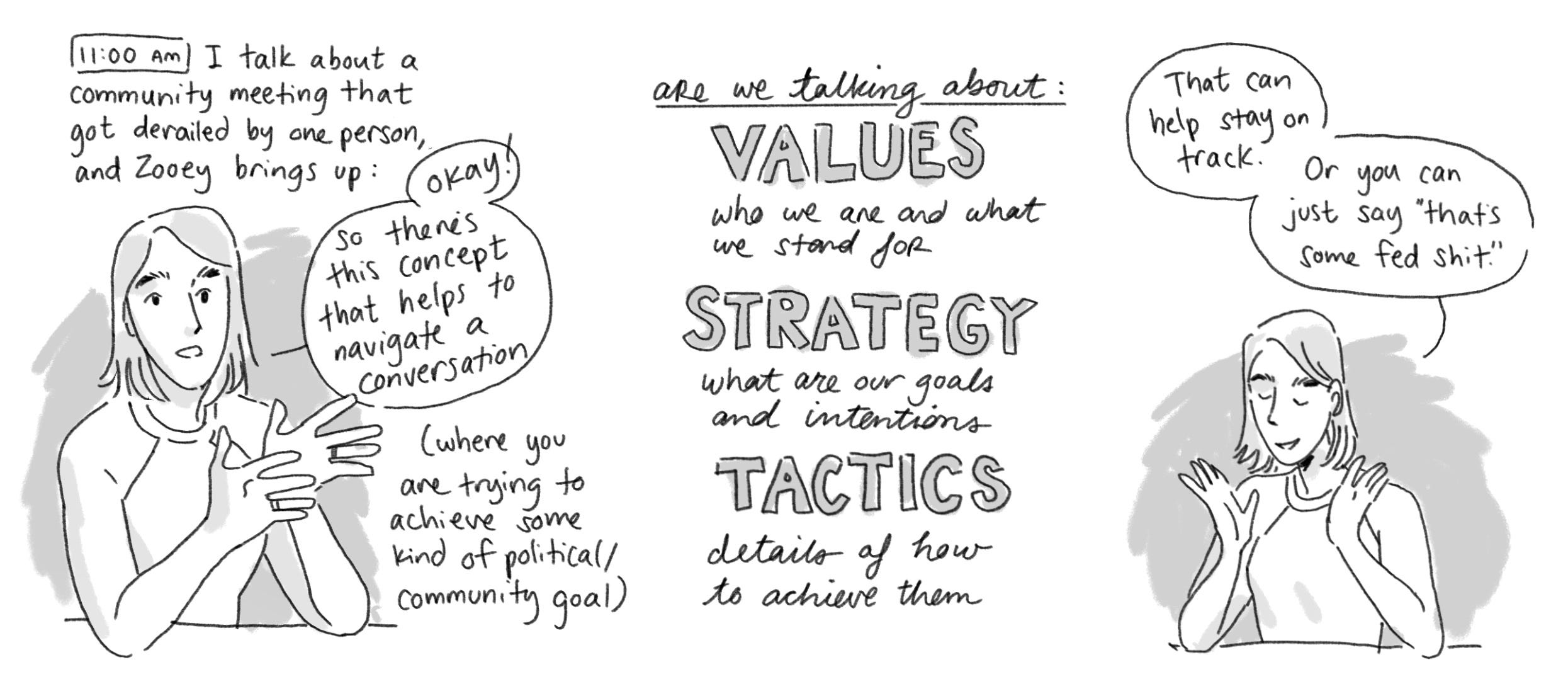
Much better than my approach of saying “Should we slide up or down the ladder of abstraction?”
I’m about to board my New Hampshire flight (I’m running?), so here are my questions for you:
My father was a brilliant scientist and taught me very early that the experiments that fail are very important and must be written up honestly. So in eighth grade I wrote up my failure to grow crystals, and some theories on why I failed. The teacher gave me a low grade and explained that this was unacceptable, but she also moved me over to the topmost science class section. Maybe - apparently - she also thought the whole thing was a bit of a charade.
You are certainly right that science fairs have lost their way and would profit from a best Blind Alley prize. And a "no grownup touched this project" prize.
Maybe the adult scientists could use such a prize too, given the rate at which they are faking results and having to retract them from prestigious journals because they are not committed to truth over their jobs, which depend on "not being wrong." Well, being wrong is extremely important, and reporting it honestly so that every one else does not go down your same blind alley is a great contribution to science. Best Blind Alley could be great.
When I was in middle school, the *point* of the science fair was to learn the scientific method. I remember seeing an experiment that asked whether hold or cold water would freeze into ice first. You can look at this and think "what a dumb experiment, the answer is obvious" or you can look at this and say "what a great way to learn the method." The point wasn't actually to figure out whether hot or cold water froze first; the point was to walk through the method, to have the experience of doing it.