

Three quick notes up top: First, I’ll be leading a Chaplet of Divine Mercy for peace tonight starting around 7:55p ET. If I’m not there on the dot, it’s because I’m finishing up bedtime with my kids.

Second, at The Dispatch, I got to dig into a question that I’ve wondered about for a long time: What kind of death threats count as crimes? I interviewed both a first amendment lawyer from FIRE and a journalist who has had to triage the many threats he receives.
Finally, Ave Maria Press is having a spring sale, which means my conversion story, Arriving at Amen, is available for $8. A teaser from the opening page: “[When I saw Les Miserables] I didn’t fall in love with tragic Éponine or fearless Enjolras or noble Jean Valjean, but with Javert, the story’s antagonist.”
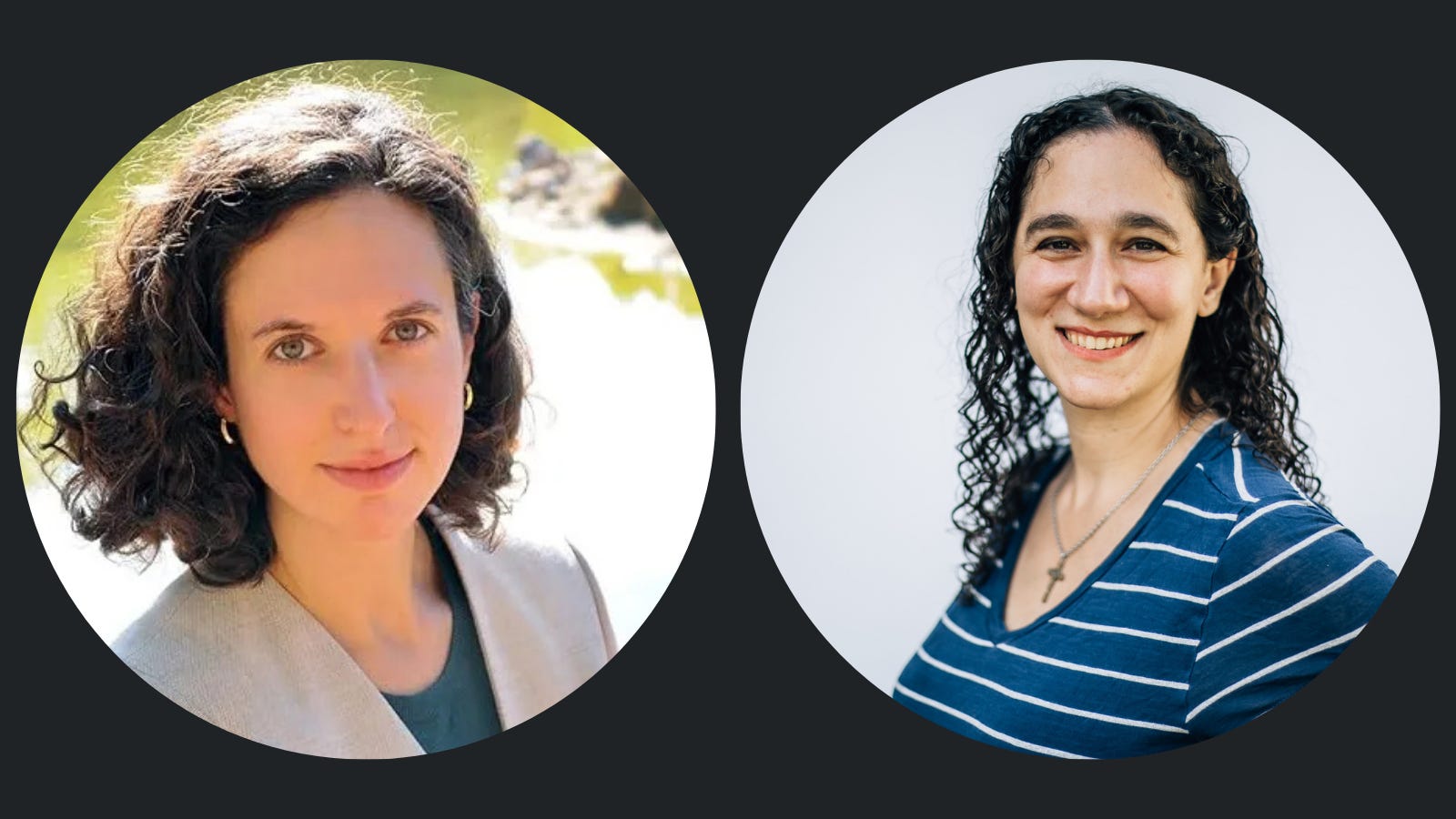
I was delighted to sit down with Ilana Yurkiewicz, MD to talk about The Dignity of Dependence and her work improving primary care.

Here’s an excerpt from our conversation (I’ve edited the transcript a little for brevity).
Ilana Yurkiewicz:
I want to talk about the economics in the workplace as well. You write a lot about that. Many workplaces can be openly hostile to illness or disability. As a physician, I have learned that my signature can be one of the most powerful tools I have to give chronically ill patients protected time to step away from work that otherwise treats them like widgets.
They can step away to inject insulin, they can attend appointments, they can take their medications. I often write for intermittent FMLA for people to be able to do this. Yet often I and my patients face employer pushback anyway, because modern workplaces are built largely to squeeze maximum productivity from able-bodied workers.
I believe that squeeze leaves zero room for dependence or illness. How do we create workplaces that treat workers like real human beings with real needs and not widgets?
Leah Sargeant:
I’m not sure exactly how we get there, but I can talk about an example of somewhere that does this differently and how they got there. There’s a group called the Bruderhof, who are an Anabaptist community. They built a factory as part of the way they were supporting their community.
Now, they hold all their goods in common. So the point of the factory isn’t to enrich the owner of the factory. It’s for the community together to make something that is viewed as valuable by the world that the world will pay them for. In the same way that monasteries might make beeswax candles or have some other industry that helps support their work.
So when the Bruderhof were designing their factory, they said, well, this is a factory that’s meant to employ our community. So we’re not going to start from the assumption of we get to pick whoever we want to work here. We can’t say we’re only hiring 20 to 30 somethings who don’t have kids. We’re employing almost anyone in our community, including the elderly.
So they designed their factory with the assumption of this factory needs workstations that accommodate people as they are. And the Bruderhof had the sense of stewardship of their community. They had to design the job so it could employ the people nearby. And I think that’s just not a way that most workplaces think through this.
I’m a big fan of Ilana’s work and I got to review her book Fragmented: A Doctor’s Quest to Piece Together American Health Care for National Review. Here’s an excerpt from my piece:
The range of treatments that doctors can offer has gotten more and more advanced. Robotic suturing tools allow surgeons to conduct delicate surgery through minimally invasive laparoscopic procedures. CAR T-cell immunotherapy can be precisely tuned for individual cancers, teaching patients’ immune systems to kill their tumors. But when it comes to medical record-keeping and continuity of care, many doctors like Yurkiewicz find they’re operating in an era of oral history or as archaeologists.
In her practice, Yurkiewicz reconstructs a patient’s medical history as though she were piecing together potsherds at a dig site. She asks other doctors to mail her CD-ROMs of medical images (and then borrows a disc drive to be able to view them). She pores over pages of blurry, out-of-order faxed records. And often, she turns to the patient as her co-investigator, asking questions such as, “What did the testing show? Was it a loud machine where you lie flat, or did someone use a probe coated with cold gel?”
…Michael’s doctors have medical expertise, but it’s his wife who’s an expert on Michael. It’s she who is the first to realize that his new provider didn’t follow his discharge treatment protocol and that neglecting to properly administer his sodium infusions is killing him. But it’s hard for her to be heard — when she brings up her concerns, she’s initially told, “This is just the progression of his illness. He’s a sick person, you know.”
In Christianity Today, Matthew Loftus has a piece that complements Ilana’s work. He’s focused on what Surgeon General nominee Casey Means is missing, that she might have learned if she’d spent time working in primary care.
Changing health behaviors is critical to getting control over chronic diseases. Means complains in her book that doctors are too quick to prescribe pills when “an ultra-aggressive stance on diet and behavior would do far more for the patient in front of them.” Means, who didn’t finish her ear, nose, and throat residency and doesn’t hold an active license to practice medicine, makes a good point. But has she ever sat with recalcitrant patients and tried an “ultra-aggressive stance on diet and behavior” with them?
Anyone who has practiced primary care medicine, as I have for over a decade, will tell you it’s not as simple as that. In fact, most patients will avoid coming back to your office if you try to be “ultra-aggressive” about any behavior in their lives. Means and RFK Jr. overestimate the power that individual lectures from doctors have on their patients’ choices and habits, which is not surprising considering that neither of them has ever treated chronic diseases like hypertension and diabetes over the long run…
I train medical students, interns, and residents nearly every day as part of my work as a family doctor. These trainees, because they have more classroom experience than clinical time treating patients, often come up with diagnoses and prescriptions that sound good on paper but won’t work because they don’t have the wisdom that comes after seeing and treating many patients. They don’t know what they don’t know, and when they’re not carefully supervised, they can do more harm than good.
The Bruderhof with their factory, and Drs. Yurkiewicz and Loftus with their patients are deeply concerned with the reality of the person they aim to serve. If they engage with an imaginary, idealized version of the community or patient before them, they will design systems that don’t work.
And, often, the blame will be placed on the aberrant or disobedient subject, not the practitioner.
I constantly struggle with the lack of detail on prescription medication instructions, because many drugs kind of require you to schedule your life around your meds for them to work correctly. If I had more information on the bottle about *why* I need to wait an hour after taking something to eat, instead of just “do this,” I would feel a lot less like I am being treated as a robot that can easily handle weird adjustments to meal & sleep schedules. Sometimes a drug interaction could have serious consequences, but in other cases fudging the instructions might just mean marginally less drug absorption. If it’s the latter, and would lessen the disruptions to daily living, that should be something patients should know.
I constantly gripe about how medical practices make a big deal about being on time (or billing you anyway if you aren’t), but as patients we have little recourse for doctors being late or canceling appointments at the last minute, which is especially infuriating when some of these have been on the calendar for months and require childcare arrangements. While medicine can be unpredictable, just showing up on time is often 90% of me having a positive experience at the doctor.
Another big one is more insurance-related. Despite being the parent who handles the majority of our children’s medical care, insurance tends to build their business and services around the subscribers, so although I have a right to our children’s data as a parent, I frequently lose access to online insurance records as a dependent spouse, simply because of the way they build & update their website. I imagine we are not the only family who has this problem.
> Where have you encountered a professional (at work or in medicine) who kept rejecting the actual people in front of them in favor of an imagined ideal?
Establishing nursing with my firstborn was, to put it mildly, not straightforward. One of the worst moments was having a lactation helper write in the chart that I wasn't compliant with their recommendation to pump for X minutes after every feeding. They didn't seem to understand that we were attempting to nurse so often and for so long that I couldn't even tell what counted as "a feeding", let alone find X spare minutes in between to pump and still be able to eat and go to the bathroom and such. This is maybe just my experience talking, but I think the lactation and motherbaby-care world is especially prone to this problem, especially since 2x the number of patients = more than 2x the complexity.
> Where have you redesigned a system or replanned an event in order to accommodate people as they actually are?
I am trying to shift my parenting problem-solving to this mindset. There's a certain genre of unhelpful parenting advice that I like to call "Have you tried simply not having that problem?", which involves wishing that circumstances/abilities/needs were magically different, rather than taking an honest look at the people and situation.