

.jpg)
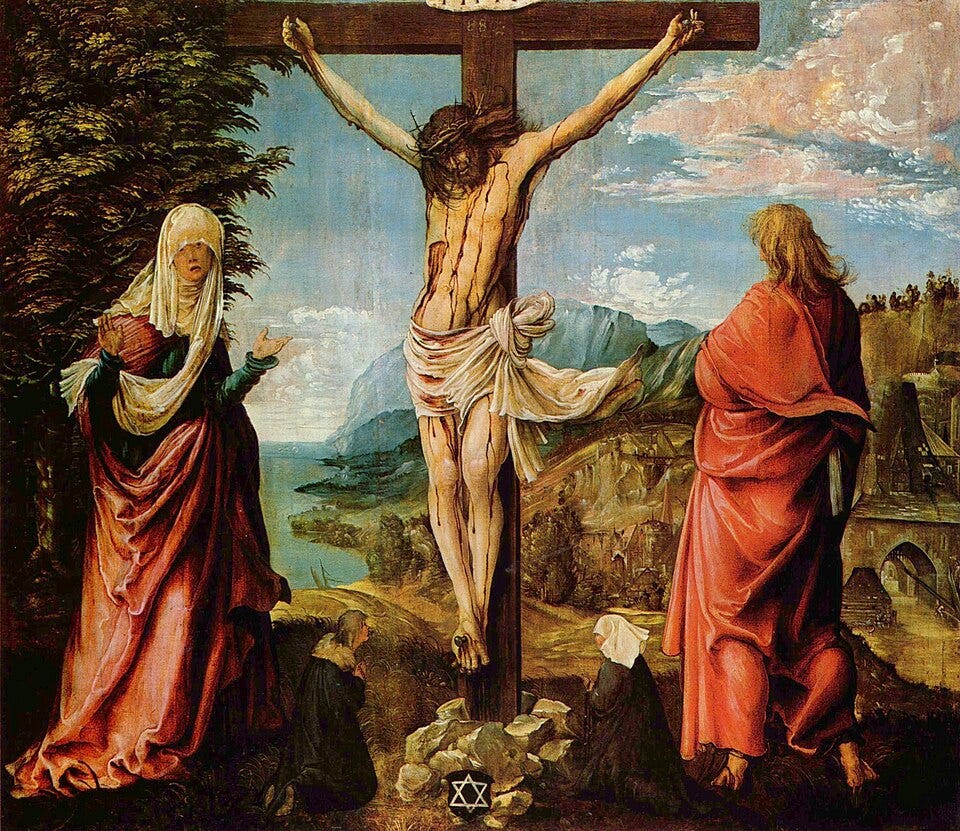
Today, on Good Friday, I wanted to share an excerpt from Pope Leo’s homily during the Chrism Mass in Rome, which seemed Other Feminisms-relevant:
Dear friends, we follow Jesus who “did not regard equality with God as something to be exploited, but emptied himself” (Phil 2:6-7). Every mission begins with that kind of self-emptying in which everything is reborn. Our dignity as sons and daughters of God cannot be taken from us, nor can it be lost, but neither can the affections, places, and experiences at the start of our lives be erased. We are heirs to so much good and, at the same time, to the limitations of a history into which the Gospel must bring light and salvation, forgiveness and healing. Thus, there is no mission without reconciliation with our past, with the gifts and limitations of the upbringing we have received; but, at the same time, there is no peace without setting out, no awareness without detachment, no joy without risk. We are the Body of Christ if we move forward, coming to terms with the past without being imprisoned by it: everything is restored and multiplied if it is first let go, without fear. This is a fundamental secret of mission. It is not something that is experienced just once, but in every new beginning, in every new sending forth.
Jesus’ journey reveals to us that the willingness to lose oneself, to empty oneself, is not an end in itself, but a condition for encounter and intimacy. Love is true only when it is unguarded; it requires little fuss, no ostentation, and gently cherishes weakness and vulnerability. We struggle to commit ourselves to a mission that exposes us in this way, and yet there is no “good news to the poor” (cf. Lk 4:18) if we go to them bearing the signs of power.
I also appreciate this homily in the context of America’s 250th anniversary this year, to which this quote seems apropos:
We are heirs to so much good and, at the same time, to the limitations of a history into which the Gospel must bring light and salvation, forgiveness and healing.
Later this summer, I’ll show my kids the musical 1776 for the first time, as we celebrate July 4th.
At the beginning of September, I’ll invite over grown up friends to watch Come From Away. It’s a musical about the real story of travellers from all around the world who were stranded in the tiny Canadian community of Gander when American airspace closed on 9/11.
Neither musical asks us to found our hope in a denial that we live in a world wounded by sin. We receive our history as a gift, both the good (which we hope to preserve) and the bad (which we ask to be trusted to mend, as best we can).
The other quote on my mind is from Richard John Neuhaus’s Death on a Friday Afternoon. This Good Friday, I have two vigils to keep—one on the Way of the Cross in DC, and the other in a hospital room across town, with a college friend who is not expected to recover.
In Death on a Friday Afternoon, Neuhaus offers meditations on each of Christ’s utterances from the Cross. This comes from the chapter on “It is finished.”
In what we think of as the piety of a simpler time, Christians undergoing trial or affliction were urged to “offer it up.” I recall being deeply impressed as a young man by the death of Pope John XXIII. It was slow in coming, and over the days there were regular news bulletins reporting that he was offering up one day’s suffering for those with cancer, another day’s suffering for homeless refugees, another for mothers with difficult pregnancies and so forth. He seemed to be going about his dying with such purpose, with almost workmanlike efficiency, wasting none of it.
I’ve found this passage very helpful as a door into hope in my own life.
And in my book touring for The Dignity of Dependence, I think one theme that has come out with stronger emphasis in response to discussion and questions has been the idea of stewardship. I cite Lewis Hyde’s The Gift in the book, but I probably could have cited it more!
My prayers for you and your friend, blessed are those who suffer on the days of the passion of Our Lord, and those who comfort them like the women under the Cross.
Please pray for one of our beloved parish priests, who yesterday joined Him in heaven.
I am so sorry to read of your friend. I pray many mercies on both of you.
I find it challenging to receive my body as a gift; however, at the risk of stating the obvious, the gift of bearing, breastfeeding, and comforting children (and comforting others with hugs, touches, and eye contact) are such a tremendous gift. Our bodies give the Holy Spirit so much power through them, and I am grateful in spite of more fat on my body than I'd like, a recent bout with melanoma, and three recent ankle surgeries.
I'm not sure if this answers your second question, but I find a perfect match in my intense love of babies, and a need of holding for babies in our county hospital's NICU. I volunteer there for two hours a week, and it's truly the highlight of my every week.
I have felt the limits you describe in the serious illness (liver disease as a result of addiction is suspected) of someone I love. I feel so helpless to help them in their pain and their hopelessness. As I shared with them recently, though, loving them is a privilege in my life. It is a blessing to know and care for them, even though (because) their sickness is ripping my heart wide open.
Beautiful thoughts for Good Friday. I leave soon to cantor our celebration of the Passion. Thank you for blessing us with your writing.