

As you go into the weekend (and I am trapped for now in the Cleveland airport), I wanted to share great two stories of medical breakthroughs for moms. Both are targetted at the developing world, and neither required a breakthrough in developing new drugs—just using the tools we have in smarter ways.
First up, via the NYT, “An 80-Cent Plastic Pouch Is Saving Thousands of Women From Dying in Childbirth.”
The innovation here is a “maternal drape,” a sheet of plastic placed under a woman giving birth that funnels any blood she looses into a pouch with prominent volume measures. It makes it apparent at a glance how much blood the mom has lost, without trying to estimate how much has soaked into different clothes. It gives doctors and midwives the clarity to act quickly:
The midwife who caught baby Aabid saw blood running into the pouch and quickly reaching and surpassing the danger level — 300 milliliters (or 10 ounces), indicated by a mark on the pouch.
The midwife swiftly grabbed a cart stationed in the middle of the packed maternity ward, called for help and went to work. From the cart, she took a syringe of the drug oxytocin and injected it through an IV to get Ms. Balarabe’s uterus to contract. She added a dose of tranexamic acid, to prompt clotting. She massaged Ms. Balarabe’s abdomen, encouraging more uterine contractions, while a nurse started IV fluids to restore her blood volume. The bleeding slowed, and after a couple of minutes, it stopped altogether.
It was all so swift and smooth that the new mother had no idea there was cause for alarm.
One in every 10 women who give birth experiences postpartum hemorrhage, and at least 70,000 women die from it each year. Almost all of those women are in low-income countries; more women die giving birth in Nigeria than in any other country.
The article notes that hospitals have made a two-part change to protect post-partum mothers. The maternal drape helps staff know when to act, and the second change is to how they act. Now, doctors surge support in the case of a possible hemorrhage, rather than escalating treatment slowly.
The drapes are being manufactured in Nigeria, at a price the government can afford, thanks to the Gates Foundation providing initial capital:
Dr. Muhammad Ali Pate, the health minister, wants Nigeria to make more of what it needs. So Dr. Galadanci and her team got in touch with a family-run plastic manufacturer in Kano that made plates, forks and containers for things like vegetable oil. Dr. Galadanci showed the chief engineer a drape: Could they make that?
The company made a prototype, but it was clear that any significant production would require custom-built machinery, which it would need to import from Taiwan. The Gates Foundation, which had helped fund the drape research, was eager to scale up the drape’s use, and offered a $600,000 grant. (The foundation has also backed companies in Kenya and South Africa, where the drape was tested, to manufacture them.)
In exchange, the company, Systs Engineering, agreed to sell the drapes for 70 cents each to the national health system. The war in Iran has since pushed up the cost of raw materials, so these days, the drapes cost 80 cents. The company is making them for all of Nigeria, and it has started to export to some neighboring countries.
I’m so happy to see this. It reminds me of Atul Gawande’s Checklist Manifesto.
The other encouraging story comes from In Development Magazine (a consistently fascinating read):

The piece is focused on where the use of auto-injectors (like Epi-Pens) could be expanded in the developing world. Here are their criteria:
In emergency medicine, autoinjectors are most useful when:
There is no oral option for treatment. The drug either isn’t absorbed fast enough by mouth to work, or an oral drug doesn’t exist.
Minutes matter. Timely administration of the treatment has a critical impact on patient outcomes and mortality. This is often linked to the first; if an oral drug isn’t fast enough, it is likely that minutes will matter.
No clinician is in reach. The person best placed to give the treatment is usually a parent, a bystander or the patient themself — not a clinician requiring access to an intravenous (IV) line.
This leads them to maternal hemorrhage. Every minute matters when a mother starts bleeding uncontrollably.
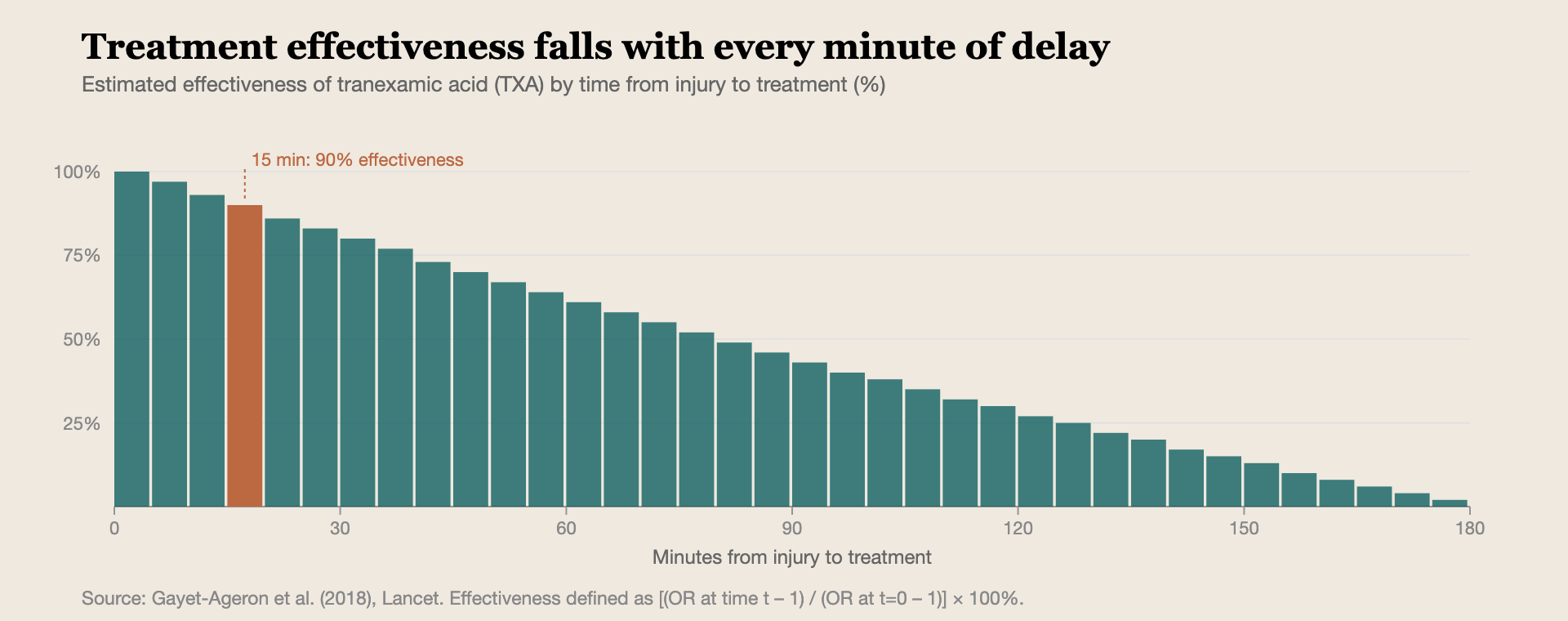
Many mothers in developing countries give birth outside a hospital, with no IV line or anyone qualified to start one.
In sub-Saharan Africa, a third of births occur outside a facility, and nearly three in ten women of childbearing age live more than two hours from their nearest hospital. So although TXA was discovered over 50 years ago and is available cheaply as a generic, few of these women receive it — no one present at the birth is trained or equipped to give an intravenous drug.
Auto-injectors are only potential good news for moms, which the maternal drape is already being rolled out. It’s hard to get manufacturers to design well for the developing world as it is, rather than to offer tools tuned to the developed world, and wait for hospitals to catch up.
Development of a TXA autoinjector has begun, but it is unlikely to address these particular issues. Current development is oriented towards trauma care gaps in high-income countries — accidents, mass-casualty events and battlefield injuries. A device built for these buyers may not transfer well to LMICs: It may assume climate-controlled storage in ambulances and stockpiles, use costlier components like automatic needle shields, electronic voice or light guidance or be engineered to withstand battlefield conditions — a level of robustness not needed for an at-home birth. And there is little incentive to strip these features out when high-income procurers are willing to pay for them.
Just as the Gates Foundation stepped in to help with the start up costs of the maternal drape, philanthropy could bridge the gap to a TXA auto-injector, and I hope In Development’s story keeps getting shared till it reaches the right funder.