

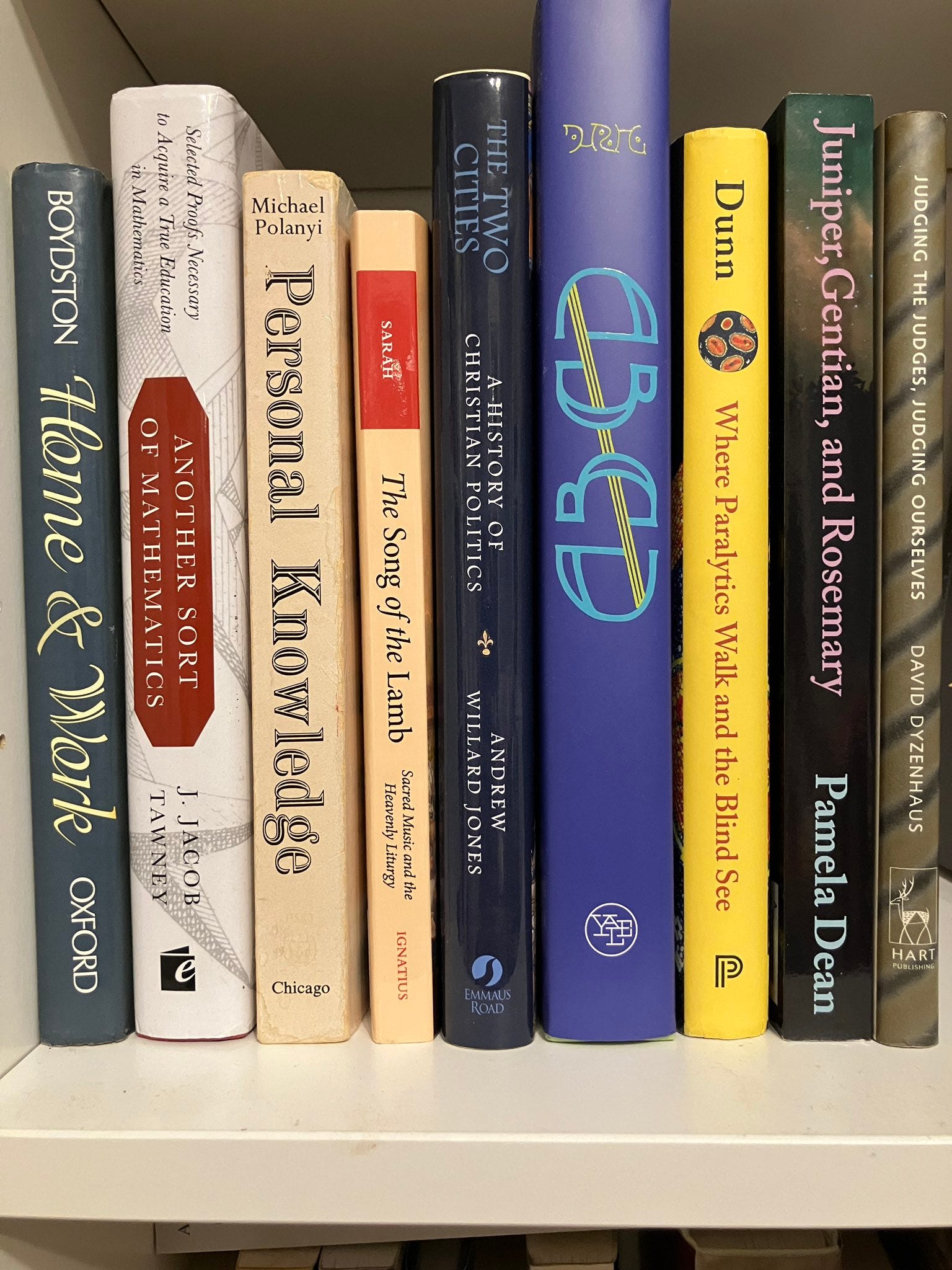
Every year, I make a reading list drawn from books I already own as of January 1st. My list is a way I give myself permission to prioritize these books over other reading that feels more urgent but less important (e.g. finishing the newspaper, getting to my library holds, etc.). The list takes the books from ones I could finish at any time to ones that deserve my attention right now.
Last year, I finished all twelve books on my 2025 list (the last one at 11:20p on December 31st). It helped a lot being on book tour (sans kids) for The Dignity of Dependence in the back half of the year. This spring won’t be as busy (probably about six book trips away from home) but I’ve gone mad with hubris and put fourteen books on my 2026 list.
Home and Work: Housework, Wages, and the Ideology of Labor in the Early Republic by Jeanne Boydston
Juniper, Gentian, and Rosemary by Pamela Dean
Where Paralytics Walk and the Blind See: Stories of Sickness and Disability at the Juncture of Worlds by Mary Dunn
School of Shards by Marina & Sergey Dyachenko
Judging the Judges, Judging Ourselves: Truth, Reconciliation and the Apartheid Legal Order by David Dyzenhaus
Ambigrammia: Between Creation and Discovery by Douglas Hofstadter
Something for Nothing?: An Explanation and Defence of the Scholastic Position on Usury by David Hunt
The Two Cities: A History of Christian Politics by Andrew Willard Jones
Alasdair MacIntyre: An Intellectual Biography by Émile Perreau-Saussine
Personal Knowledge by Michael Polanyi
Fantasy: A Short History by Adam Roberts
Song of the Lamb: Sacred Music and the Heavenly Liturgy by Robert Cardinal Sarah and Peter Carter
Let the Record Show: A Political History of ACT UP New York, 1987-1993 by Sarah Schulman
Francis of Assisi: A New Biography by Augustine Thompson
As you can see, there’s something of a post-book publication pause on my beat. Only two books, Home and Work and Where Paralytics Walk and the Blind See, are clearly Other Feminisms-coded.
But I started Let the Record Show last year (and stuck it on the list anyway, because I still have a lot to go) and I think this note from Schulman on why ACT UP succeeded in its confrontational activism is of interest to anyone who wants to change the world:
Experience-Based Agenda: Identify your issues based on the lived experiences of people with AIDS.
Education: Become the expert on your subject.
Design the Solution: Instead of acting in an infantilized relationship to those in power, begging them to solve problems, ACT UP used their acquired and innate expertise to design reasonable, doable, and winnable solutions.
Present This Solution to the Powers That Be: And when they refuse to listen …
ACT UP’s process of “self-purification” was a combination of nonviolent civil disobedience training, emotional and political bonding through the creation of affinity groups, and the putting in place of highly organized support systems of marshals and volunteer lawyers to ensure that no one would get lost in the system. Teach-ins created a highly informed rank and file, all of whom were encouraged to be spokespeople because “people with AIDS are the experts.” Sophisticated media workers combined grassroots video activism and high-level media contacts to present ACT UP’s demands.
Then ACT UP would perform nonviolent direct action to, as facilitator Ann Northrop would say, “Speak through the media, not to the media.”
Thereby, ACT UP created public pressure on the powers that be to move toward ACT UP’s reasonable, doable, already designed solution.
I picked up the book because I’m interested in the period and in what it can illuminate about why confrontational activism does or doesn’t work today. (This is part of why I followed Red Rose Rescue members on an attempted abortion clinic sit-in for a reported piece, and interviewed one of their leaders before she was incarcerated).
Two things that stand out so far is that activist groups (of all stripes) seldom have the precise, actionable demands that ACT UP deployed. More groups do take the “infantilized relationship to those in power, begging them to solve problems” that Schulman describes, which makes it hard to be given a simple, immediate win.
ACT UP also operated in a very different media environment, when activists could expect that when they “spoke through the media, not to the media” they would be seen by ordinary people. Our fragmented media landscape is very different.
Many of ACT UP’s actions were more novel and shocking at the time than they would be when repeated now. A mass protest outside the FDA is unlikely to make the nightly news. Even their most provocative stunts, like disrupting Mass at St. Patrick’s Cathedral in NYC, are not shocking now. (Back then, there was substantial internal division about whether it was a good idea / whether all demonstrators should be careful to only disrupt the homily, not the prayers).
I’m looking forward to finishing the book and to the rest of the list!
You've convinced me to read LET THE RECORD SHOW!
I love the idea of prioritizing books I already have and keep meaning to read. I'm going to have to consider how many I can realistically put on the list with baby on the way, though.
I mostly read fiction with a sprinkling of history/biography. Last year, Hannah's Children by Catherine Ruth Pakaluk (a survey of college educated American women choosing to have 5 or more children) was a standout among my Non-fiction reading. The Feast by Margaret Kennedy was a surprise buzzer beater in fiction, as I read it during the week of Christmas.
I just started Our Mutual Friend as my Dickens audiobook for the year and Green Dolphin Street as my bedside table read. Both are off to a delightful start.
I have a book club on Little Women this week and one on The Awakening of Miss Prim later this month (a sort of Hallmark channel light-romance-style novelization of Dr. John Senior's The Restoration of Christian Culture, the book is a first novel and in translation from Spanish, so the writing itself isn't remarkable, though it's an easy two-day read, but I'm very interested to discuss steps other people are taking to build community -as the book shows- in their real lives).
I may dive into The Civil War vol 2 by Shelby Foote, but then again, I'm having a baby this year and my hormones may not be ready for that much death, even though the first volume was great. (I was impressed how modern 1860s was! When telegraphs can communicate across the country and the newspaper can print by the next day, it really felt like President Lincoln could receive text messages and the country was fairly quickly informed about the latest news (or misinformed, as the case may be!).)
I always pick a book to be reading before/after giving birth that I can tell that child was "their" book, so they can read it when they're a teenager if they choose. (In eighth grade, I read the mystery book my Mom was reading the day I was born, which felt so fun!) I reread the Anne of Green Gable series after having my daughter and read Master and Commander as a fun boy book for my son. We're having another boy and I'm deciding on what book to pick for him. Treasure Island? Around the World in 80 Days? The Jungle Book? Peter Pan? I'll have to put some thought into it!