

I got to do a podcast on how to have better disagreements with the CBC, and I really enjoyed it. You can listen to me right at the top of this episode, and I’m very amused to report they overlaid my imitation of John McLaughlin’s “ISSUE ONE!” over a clip of him doing it. (Yes, I sat down and watched the McLaughlin Group as a preschooler with my parents, perhaps it is why I am this way).
I’ll be speaking about my book, The Dignity of Dependence, and the future of the pro-life movement on March 14 on Long Island.
I really appreciated a recent post by Débora Luciano that was sparked by Carrie Gress’s critique of feminism in Something Wicked. (My review of Something Wicked is here, and for this post, I’m just engaging with Luciano’s ideas, not relitigating the review).
First off, I appreciated (and fully agree with) Luciano here on how incoherent it is to treat feminism as a single ideology (especially across multiple waves). There’s a reason (well, several) that this substack is called Other Feminisms. As Luciano puts it, to argue that there has just been one feminism, leaves you stuck with this:
Feminism is not treated as a tangled web of historical movements, internal disputes, theological tensions, and philosophical mutations. Instead, it is presented as a single, unified Movement, complete with a stable philosophical essence and a shared core, intact across centuries and immune to qualitative change. Mary Wollstonecraft, Simone de Beauvoir, and contemporary radical feminists are not divided by incompatible frameworks; they participate in the same underlying philosophy, even when they speak in different idioms.
When I give talks on my book, I try to give a clear definition of what I mean by “feminism” early on. I don’t expect everyone to agree with my definition, but I don’t want them to be distracted by attributing what they think a feminist must be to me (and being mad when I don’t fit). What I say usually goes something like this:
Feminism is more of a braid of multiple factions than a single, unified movements. And there are plenty of feminists who think I shouldn’t call myself one. So, to give my own definition, I think feminism is, at its heart, a collection of people deeply concerned with what it means to be just to women, as women, not as defective men or generic, unsexed human persons. I certainly disagree with some other feminists on what justice consists of here, but I think we’re all concerned with fundamental asymmetries of sex and how to respond to them.
Luciano concludes her post by identifying what she sees as the root of feminism. We agree that it’s about a response to embodiment and assymetry, but she defines it as being a very particular response:
Feminism does not exist merely as a loose aggregation of political demands. It does function, in many of its historical forms, as a movement — with a capital M — possessing a certain internal unity and a shared metaphysical core.
At its center lies a metaphysics of revolt: a gnostic refusal of feminine suffering, of incarnation, and ultimately of creation itself. From this perspective, feminism does not merely contest social arrangements or moral norms; it claims a REVOLUTION. In this sense, it is structurally incompatible with Catholicism and with those forms of Protestantism that preserve the Christological grammar of incarnation and mediation, including the affirmation of the Theotokos, Mary as Mother of God.
Luciano and I are in agreement insofar as this is definitely one of the strands in the braid of feminism. How do you respond in justice to the asymmetries of embodiment? One possible answer had always been by attempting to correct the asymmetries and transcend the body.
This is why, in “Designing Women,” (an essay I wrote at Comment), I was focused on how three groups (transhumanists, people with disabilities, and women) respond to assistive devices and other tools to extend or fix the body:
The most audacious body augmentations are pioneered by two groups: hobbyist enthusiasts and people navigating disabilities. The enthusiasts often want to expand the range of what we see as human. People navigating disabilities, however, feel that they are forced to become inventors to navigate a world that is hostile to their body and prefers they reshape it into a more expected form. The disabled inventors are making a case that our idea of what is human doesn’t include everyone who is human…
Most of the famous transhumanists are male, but most of the practicing transhumanists are women. When the world makes demands of women that are impossible to fulfill, we are offered ways to “fix” our bodies. Unaugmented, many women find that female bodies and female fertility are expected to be standardized and made “safe” to be welcome in the world.
For the most part, I’m more interested in explaining what I mean by feminist than in persuading people that mine is the central definition. (If it were, I wouldn’t need to call this substack “Other Feminisms.”) I do think that rejection of embodiment isn’t the only reaction to sex-based asymmetries—I think it’s one strand in the braid.
Ultimately, I think most movements and ideologies have some degree of pull toward “a metaphysics of revolt: a gnostic refusal of feminine suffering, of incarnation, and ultimately of creation itself,” because the body is both gift and cross. Cross is the idea everyone can agree on, religious or not. Gift depends on believing in a giver that has ordered Creation (even the hard parts) out of love.
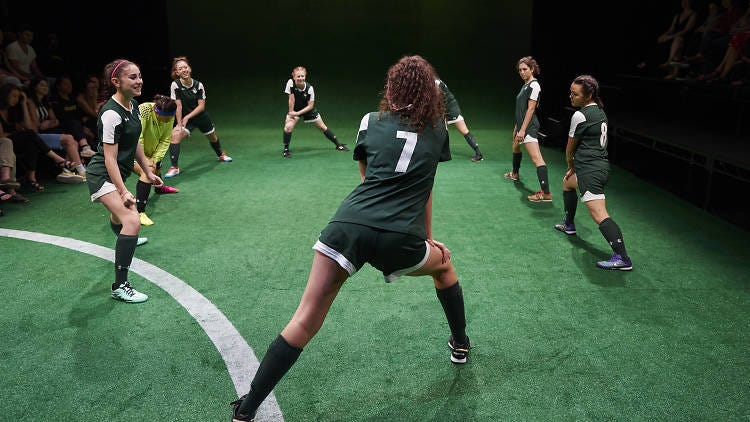
It’s easy to fall back into thinking of your body as a (slightly faulty) tool. I fall into these patterns of thoughts, even after writing a whole book to talk myself out of it. And I really appreciated a feature in The New York Times Magazine this weekend on ACL injuries in girls’ soccer which seems apropos to this whole discussion:
In July 2022, a few months after her second injury, I watched trainers hoist another of my daughter’s friends onto a cart — another torn A.C.L. The next summer, that girl, too, ripped the ligament in her other knee. In the fall of 2023, three girls on my daughter’s high school team also ruptured their A.C.L.s. Soon the tally of torn A.C.L.s among my daughter’s current and former teammates would reach an astonishing number: 19.
Craig Welch, investigating why his daughter and her friends are suffering disabling injuries in their sport, lands on what I would call typically feminist (positive connotation) concerns. Girls are 3-6x more likely than boys to tear their ACLs in youth sports. Girls committed to year-round soccer schedules have a 1 in 6 chance of tearing their ACL before getting their high school diploma.
Partly, Welch finds, this is a matter of bodily asymmetries:
Athletic women, particularly in adolescence, also battle their anatomy. The notch in the femur through which the A.C.L. passes is smaller in women than in men. The combination of wider hips and shorter thighs can put more strain on their knees. Hormones released during menstruation can make ligaments looser and possibly increase the risk of injury.
Gender contributes in less obvious ways, too. Despite skyrocketing participation in girls’ sports, girls’ cleats are often just boys’ shoes with different stylings. (“Shrink it and pink it,” in the argot of the apparel world.) But the female foot tends to be shaped differently than its male counterpart, and it absorbs forces differently.
So far, so feminist by my definition. But Luciano’s definition haunts the piece, too. As Welch describes, there’s a pattern of stretches girls can do for about twenty minutes, which, if done consistently, significantly reduce the chance of ACL tears. But most girls (including his daughter, who suffers two tears) don’t do them. Many don’t know the option exists (few coaches incorporate them), but even for Welch, it’s hard to commit to what the body demands.
He knows he should have pushed his daughter to follow the protocols he was writing about but, “After a year of injury and grief, I was also tired of hounding my teenager. Edie was tired of being hounded.”
I don’t think this is an ideological refusal of the incarnation or a hatred of the feminine. But I do see something of a gnostic rejection of the frailty of the body. Surely, we all sometimes hope, frailty is just a brief interruption of strength. It can be frustrating to graduate from physical therapy and still need to set aside time to care for your body. Didn’t you just fix it?

Luciano and I end up with different definitions of what’s core to “feminism” but we agree that many feminists (and, by my lights, many people, male or female) have a complicated relationship with their own embodiment and limits. Are we ultimately trying to see a purpose to our frailty, or are we working to fix the janky meat suit that carries us around?
I’ve consumed a lot of the work of Dr. Stacy Sims, and expert on women’s exercise and physiology, and she says it’s imperative for female athletes to strengthen their cores, and in particular, glutes, to prevent knee injuries. With homework and busy lives, it’s often too much to expect female high school and collegiate athletes to devote time outside of practice for core avid glute exercises as well as stretches. I know because I was one, and that dad is having the same experience with his daughter. Instead, coaches of female sports teams should recognize their athletes are not small men and devote practice time for core and glute work and knee stretches. If coaches want their athletes to perform well as women and girls, they need to train them as women and girls.
I was very honored by the mention, and I also suspect that there is far less disagreement between us than might initially appear. Our starting point seems to be the same: the inescapable reality of the body and the knowledge of its suffering.
The female body confronts us with asymmetry, limitation, vulnerability, and, as you put it way better than me, dependence. For women in particular, these realities are difficult to ignore, because they are inscribed so visibly in fertility, pregnancy, and in the long history of expectations that have surrounded them.
My argument has never been that every response to this suffering constitutes feminism, nor that every revolt against suffering is misguided or gnostic in nature. Revolt itself can even be necessary, and at times redemptive. In my book Autópsia do Feminismo https://amzn.to/3OOL4qG, I trace this possibility back to the figure of the Mater Dolorosa: suffering can be sublimated, transfigured, and ultimately ordered toward the truth revealed at Calvary. The uterus has long been associated with suffering —already in the Greek hystera — yet redeemed through Christ it becomes, symbolically, closer to the ancient Hebrew word רֶחֶם, mercy or maternal compassion.
My claim (and I recognize that this was not entirely clear in that article) is simply that the modern feminist movement represents one historically specific way in which this encounter with bodily suffering has been interpreted and politicized. I argue that this particular political form depends upon a specific theological genealogy — one that emerges within the context of Protestant reinterpretations of original sin, of a reconfigured Eve, and of the gradual symbolic displacement of the Virgin Mary as Theotokos and maternal mediator within the Christian imagination. I am fully aware that this is a strong thesis, which is precisely why it required an entire book to develop the argument with the care it demands.
But at the level of first principles, the reality of the body really is both gift and cross, and human beings are always tempted to respond to this reality in different ways. In that sense, I greatly appreciated your framing, because it keeps the conversation grounded where it properly belongs— not in abstract ideological labels (whether one chooses to speak of feminism, feminisms, or other terms), but in the deeper question of how we come to understand, interpret, and ultimately live with the frailty of our embodied lives.