

A lot of the two-way streets in my neighborhood still only have one lane plowed… but my kids are back in school for the first time in more than a week! So today, I wanted to share a brief triptych of built things that respond to the human body in fascinating ways.
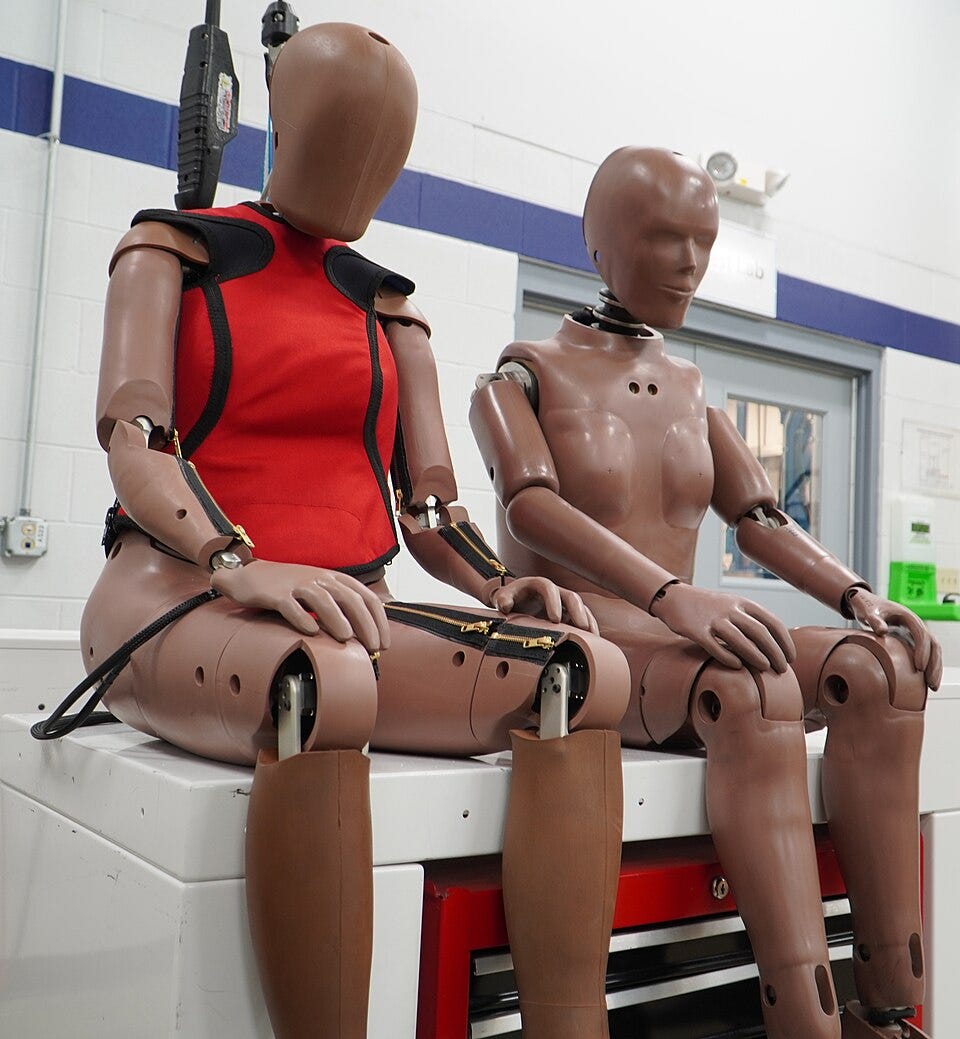

First, and most centrally Other Feminisms-y, is the news that the United States will finally (in ~2027) begin requiring car manufacturers to use a female crash test dummy as part of their safety tests. I was heavily indebted to Caroline Criado Perez’s Invisible Women: Data Bias in a World Designed for Men when I wrote about this lacuna in The Dignity of Dependence.
Relying on a tiny (5th percentile) male figure to stand in for women in crash tests is one of the more obviously dangerous ways we treat women as defective men. As I wrote:
When interviewed about these disparities by AutoExpress in 2020, Richard Schram, the Euro New Car Assessment Program’s technical director, acted as though the problem was with women, not car manufacturers. “Biologically, females are slightly weaker, and women sitting closer to the steering wheel can be an issue,” he said. “There is a difference between men and women; I acknowledge that, and I acknowledge this may be hard for women to accept.”
Schram spoke as though women sat closer to the steering wheel on a whim. But this “choice” is determined by design. In order to reach pedals that are calibrated to men’s longer legs, women slide their seats forward and place themselves much closer to the explosive force of the airbag. The airbag’s expansion is tailored to a “standard” (implicitly male) driver. The shorter a women is, the more danger she is in. During the 1990s, women petitioned to have a switch that would let a woman disable or re-arm the airbag, depending on whether she or her husband was in the driver’s seat. Car manufacturers opposed the proposed regulation. […]
The NHTSA emphasized that the danger shouldn’t be analyzed by structural differences between sexes; it was, as they framed it, a matter of personal error. “The one fact that is common to all who died is NOT their height, weight, sex, or age,” the brochure stated. “Rather, it is the fact that they were too close to the air bag when it started to deploy.” The NHTSA didn’t address how petite women could avoid this “mistake” except by electing not to drive.
I’m glad to see some real (albeit overdue) progress being made!
I’ve had this one saved in tab for more than a year (eek!) and I still love it:
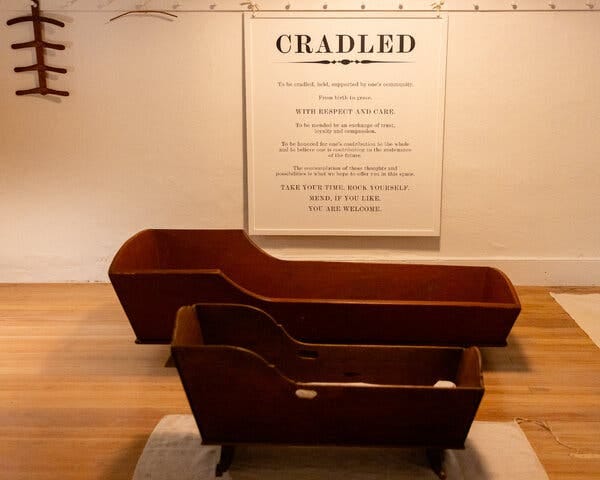
On a Thursday afternoon in late summer Frances McDormand, the actor, and Suzanne Bocanegra, a conceptual artist, were testing out a Shaker cradle for adults. The exhibit of these little-known furniture items that they put together for the Shaker Museum’s pop-up gallery was days from opening in the Kinderhook Knitting Mill — a converted historic space in Columbia County, N.Y.
McDormand climbed into the handsome, coffin-size lidless wooden box — one of several, along with a baby cradle and rocking chairs on display. She was lying on her back with her arms crossed over her chest. Her position was moribund, her mind alert.
As the article discusses, the Shakers, being celibate, had no need for baby cradles. Instead, they had to think about how to care for the elderly and the dying. (Just as a religious order does). They concluded the end might resemble the beginning:
When [McDormand] first saw a Shaker cradle in a book of photographs, something clicked. “They put so much energy into the beautiful things they made, and they were ready to comfort their people when the time came,” she said. She thought about being able to grow old in a caring community and about the regrets she had for not being around for her adoptive parents when they died. She also thought about the time she spent at the bedside of a dying friend.
“I helped with changing her diapers and feeding her and keeping her from choking,” she said. “We all need that kind of care and the Shakers seemed to really know how to prepare for it.”
Very little about our homes or furniture is designed in anticipation of aging and dying. Thinking about our parents’ coming years made my husband and me pick a house on the lower side of our street’s hill (so there’s no long set of steps to our door). But we don’t have a bathroom on the first floor, and we’ll have to fix that or move at some point if we want our home to stay hospitable.
Finally, and just for fun, I’ve always enjoyed the wild designs of Iris van Herpen, and last summer she made a dress that incorporated living algae for their bioluminescent properties.

You’ll want to check out the full feature (and videos!) at Nautilus, but this was a highlight:
Keeping the algae alive inside the gel is tricky. The cells thrive within a narrow temperature range and need nutrients and a saline solution to stay alive. The gel has to breathe, but too much exposure to the air can bring in contaminants, like bacteria or fungi, which can overgrow the algae inside. The hardest part was getting the consistency right, something “firmer than your granny’s jelly pudding,” said Bellamy, but that could still be squeezed through a syringe, molded and stitched into fabric.
The dress made its debut on the runway on July 7 in Paris, during Haute Couture Week. For Bellamy, the most interesting part of the project was observing the relationship that developed between Iris’s atelier and the material. “The material has a bedtime, the material has a wake-up time, the material gets jet lagged,” he said. “It’s that fragility that makes livingness so beautiful.”
A coffee shop near me has ~4 steps and a ramp to its entrance--but the ramp is built into the landscaping, a gently sloping brick-paved path with plants growing along all sides of the ramp. (This cafe also has a nice little kids' play corner and is temptingly close to my usual grocery store...) It's beautifully hospitable, and I've been dreaming of making the entrance to our house similarly accessible. I love that the designers of this space have made the accessible/inclusive option the more enticing and apparently more intentional one.
My sister and my mom and I just read Being Mortal, and accommodations that will help my mom stay in her house as she ages are something we discuss often (even though she's super active and healthy at the moment!).
My mom moved states to be near me and now lives nine houses down from me, on the same side of the street, in a walkable neighborhood. We walk to church and the library every week and she can (and does) easily walk to the grocery store, her favorite soup restaurant, her dentist, and to my brother and his family's house.
It's hard to predict what symptoms of aging you'll see presented first, but "not being able to drive anymore" is a common one and an extremely limiting one for people in America (even when it's not because you're old! My brother-in-law moved to NYC straight from college and never got his driver's license until he moved to our city after 2020 and then he had to learn to drive as an adult! A young adult neighbor of ours had a seizure and is seemingly fine now, but can't drive for a year and he gave away his dog and sold his house and moved to an apartment where he could walk to work, it was just too hard to run his life without a car.).
And if you can't drive to your regular activities, like church or book club, often you lose those friends that you used to see regularly, which is additionally isolating.
So when I wanted my mom to live near me, I wanted the "easily walkable by a toddler in all weathers" kind of near me. My toddler runs to Nana's house many times a week, it really is his second home. My husband shovels my mom's driveway, and it's easier for us to do things like that because she's so close. My mom walks most places (and bikes a lot), which, depending on what fails first when she gets older, might mean that some of her routines wouldn't change if she wasn't able to drive (or wasn't able to drive at night).
We're discussing adding a first floor bathroom to her house, and have also discussed making an upstairs room a kitchenette, so that either floor of her house could be a full apartment and she wouldn't need to go between floors without assistance when she's older. My husband and I feel really really strongly about helping her stay in her house and not go to a facility, which we've had poor experiences with, with other family members.
If you want to think about what it means to take care of your parents, watch the 1930s movie Make Way for Tomorrow. You won't forget it quickly!