

First up, I have been playing a little with potential (non-pink!) stickers for people who write a The Dignity of Dependence review on Goodreads or Amazon in October. I am not a graphic designer (but I am hiring one at my day job), so I’d like your votes and your notes.
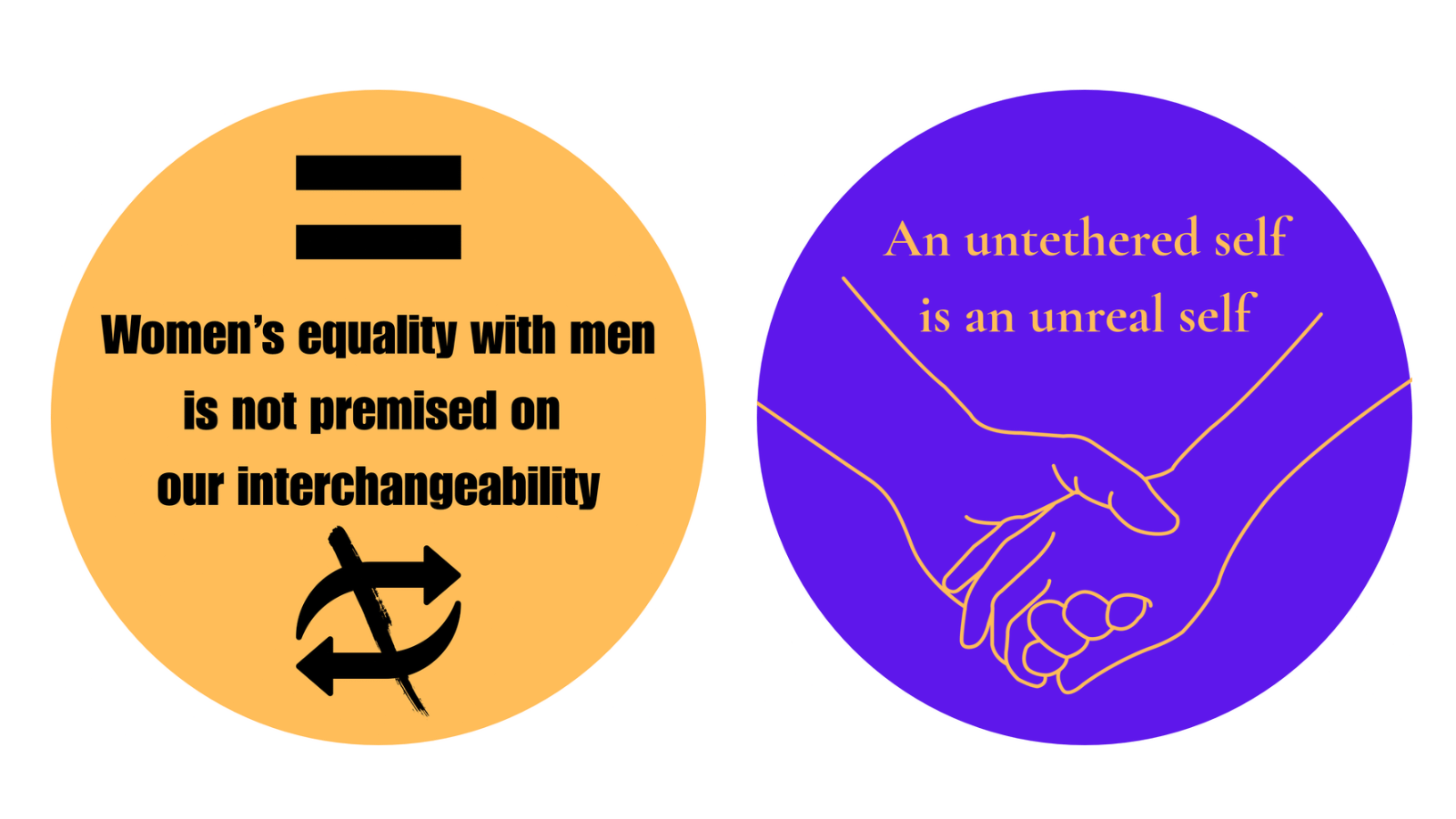
The third option I considered is “Feminism is advocating for women as women, not defective men or generic persons” but I suspect it’s a little long. You can leave proposed tweaks in the comments.
I’m delighted to finally be able to share my conversation with Dr. Matthew Loftus about his book, Resisting Therapy Culture. I appreciated you guys proposing questions, and let me repeat now the caveat I gave when I requested them.
Loftus is not against therapy or medication, but his book does take aim at therapy culture, the overspilling of therapy as totalizing ideology, ecliping the other ways we can amend our habits and relationships.
Fun fact, the main power went out a few times in Loftus’s hospital during our conversation, so there are a few interludes where he is a spooky voice in a dark room.
I’ve uploaded the transcript as a text file here. And you can grab the pure audio below.
I’ll give a little preview from the transcript (slightly compressed) of how we close our conversation:
Leah Sargeant:
Two closing questions for you, and they are both tricky and controversial and on the theme of Other Feminisms. One good faith question I get, after writing a whole book called The Dignity of Dependence, is: You are encouraging people to see weakness, frailty, finitude as core to who they are.

And you have told very beautifully both in the book and in our conversation that story of Christ saying, Do you wish to be healed?

So the question I often get is, even if even if they’re not technically autonomous, isn’t it better to think of yourself as a temporarily embarrassed autonomous person so that you’re always striving for more? Isn’t reading a book called The Dignity of Dependence in some way putting you in the position of someone who’s going to say no to Do you want to be healed? If you ground too much of your identity in, "I am finite, I am limited," will you miss up your opportunities for strength? How do you think about that?

Matthew Loftus:
It’s a balance and I think different people need to hear a different message on different days. I know I certainly do. there’s there’s times when you know, in my own struggles with mental illness I needed someone to just show me that tenderness and lean into my own dependence and there’s other times when I needed people to say like, Look, you are capable. You can change this and you can live in that more autonomous mode. But you have to want to and you really have to try.

Both things are true, right? That we are intimately dependent on one another and we can never escape that reality because that’s just who we are as as human beings and then at the same time there are more options than ever before, more ways than ever before to make ourselves slaves to the wrong thing. We have to be grateful for the power that we have, right? and the freedom that we have in Christ. and then out of that gratitude exercise our agency in the world in a way that blesses others.
As for the final question, I’ll preview it here but let you check out Loftus’s answer yourself:
All right, now the spiciest question. When it comes to ways of expressing discomfort in semi-legible, contested ways, you know, whether that is self-diagnosis and mental health contexts or chronic illnesses whose legitimacy is debated, women are overrepresented in all these groups.
I’ve heard a variety of explanations, some of which are rooted in moral accusations against women, some of which are rooted in moral accusations against the world. For example, women suffer so much and then their suffering is ignored or can only come out through these, maybe slightly conversion disorder-y problems, but that’s in reaction to a different force against them.
What, Matthew Loftus, is your hypothesis for why women are overrepresented whenever we look at kind of the fringes of what kind of suffering we feel comfortable giving a name to?
You can hear his initial answer in the video, but here’s the thoughtful addendum he sent me by email:
I wanted to add one more thought about your final question, which is that I think a posture of humility is crucial when it comes to these symptoms, their associated diagnoses, and their treatments. Experts used to think that Lyme Disease wasn’t real... until more evidence emerged. There’s a spectrum from “almost certainly fake” (e.g. Morgellons) to “We need a lot more research to figure out what’s going on” (e.g. PANDAS) to “We have an official diagnostic framework but no one knows what it really means” (e.g. fibromyalgia). A lot of things are both/and when it comes to “are these symptoms due to some abnormality in this person’s body tissues that a medicine can fix or are they primarily a manifestation of this person’s stress?” I think a lot of people find alternative medicine and MAHA appealing these days because it offers both/and solutions to a lot of problems.
Like most medical trainees, the residents I teach have to pass an exam involving actors that are pretending to be patients in order to graduate. In one of these scenarios, I recently wrote a case for our residents involving a patient who had mysterious chronic abdominal pain that had normal results on every imaginable test and had already tried all of the common treatments. I deliberately made the scoring criteria about whether or not they could actually treat the patient’s pain as legitimate even if it didn’t have a clear-cut “answer” and formulate a treatment plan that would address the patient’s concerns while also being clear that they couldn’t promise a definitive solution. Doctors need to work a lot harder on developing these kinds of skills.
Feel free to give your own answers (and your sticker notes) in the comments.
For the buttons, what about a simpler version of the same sentiment? For instance, "equality is not interchangeability" or even "equality ≠ interchangeability" instead of the full sentence?
I'm heading off to listen to the conversation now -- but meanwhile: What does "slightly conversion disorder-y problems" mean?